Showing posts with label Biology. Show all posts

Saturday, June 6, 2026

About Science Links

 As biological science advances at breath-taking rates, the websites for institutions such as research universities also change. I’ve been pleased that at least some of my links, such as to protein information at NCBI (National Center for Biotechnology Information) still exist after several years. But some sites have been removed, changed address, or are deemed insecure. Whether I write anymore or not, at this point I’m planning to move on with different theological interests, or at least different aspects of past interests. With time limits for various pursuits, I don't intend to go through my whole blog to update all links.

This post has a few important biology sites. The link to this post will be put on the blog’s side column marked "About Science Links." The side column is on the desktop version. I apologize for any inconvenience and frustration when past links are outdated. If the sites still exist but with changed addresses, you should be able to find them with an Internet search.

National Center for Biotechnology Information (NCBI) HOME.

https://www.ncbi.nlm.nih.gov/


Protein Site Guide NCBI 

Listsed under Databases:  BioProject Link (formerly Genome Project), large biological databases. 

https://www.ncbi.nlm.nih.gov/guide/proteins/


Telomere to Telomere Project (T2T): The first complete, gapless sequence of a human genome.

https://www.genome.gov/about-genomics/telomere-to-telomere


Uniprot: Database of Proteins.

https://www.uniprot.org/


RCSB PDB (Research Collaboratory for Structural Bioinformatics Protein Data Bank).
https://www.rcsb.org/

RCSB PDB Molecule of the Month by Category (amazing illustrations of biological molecules):

KEGG: Kyoto Encyclopedia of Genes and Genomes


Thursday, February 21, 2013

Muscle and More

Though I have often come back to the topics of biology and Special Creation here, I don’t intend to have a teaching blog about cell biology or genetics. Websites dedicated to teaching various disciplines abound on the Internet, not to mention school courses that are available. I have wanted to be another voice speaking about the design of biology and how I believe God created us. But I would rather write generally about this topic than specifically for the most part, and also address other concerns.

The posts I have made about biology are mostly for adults, although I believe children could appreciate them. It is adults who determine what is taught to children, and I want parents to think about how biology and evolution are presented in the schools. But some of the other themes I have written about are disturbing. I guess we are used to encountering bad interspersed with the good in our lives, but my blog wouldn’t succeed that way as a consistent lesson in Creationism. So I want to give you some references for other websites which do teach it, so you can continue to learn specifically about this subject.

I just found a Catholic Creationist site for the Kolbe Center for the Study of Creation. It looks like there is plenty there to read, including Dr. Robert Bennett, "A summary of theistic evolution" .

Though Answers in Genesis is not Catholic based, it is also a Young Earth Creationist website. It gives insight as to how the Earth shows evidence of Divine Creation. It can be a reference point for many of your questions, since it is well organized and addresses geology and cosmology as well as biology. You may be surprised how much information is available that opposes the mainstream science “party line.”

Another website where you can appreciate biology is Creation Wiki. There are different categories in the main page that will lead to entry links. They have links you can follow to other subjects.  Creation Wiki doesn’t have as many entries as some other encyclopedias, so you may have to look further for more detail. But that should be true for any research you do. Different references can be complimentary and the more you search and read, the more you learn.

There is a website called creation.com which is an international ministry for the promotion of Creationism. They are involved in an interesting campaign called “Question Evolution.” I hope they will make inroads against the enforced teaching of totally materialistic, naturalistic evolution.

I also found a site with some interesting videos of biology, DNAtube . Unfortunately, as with many scientific biology sites, you have to step around evolutionist talk.

It’s kind of amazing how much biologists and other scientists protest Creationism. If Darwinian evolution is as much a fact as they say, it should be easily apparent. However, the opposite is more like it. Fabulous designs are everywhere, and it is an exercise in futility to try to explain cell biology as random globs of molecules.

Though others may want to suppress Creationists and have tried to do so in many ways, we still have the freedom to observe and describe biology as it really is. I wish you happy hunting and learning.

~~~~~~~~~~~~~~~~~~~~~~~~~~~~~~~~~~~

All the above said, I’d still like to show you another wonderful biological design. In a recent post I talked about the tiny bio-machines that produce energy for our body. The small molecule that carries this energy to other chemical reactions is called adenosine triphosphate (ah-DEN-oh-seen try-FAHS-fate). The commonly used nickname is ATP. The mechanism for muscle contraction is one of the many uses for ATP. Our muscles have muscle cells with muscle proteins inside. These have technical names, which you can learn if you are inclined. But you don’t have to know their labels to see the way they operate. An explanation of muscle is at the Wikipedia website HERE and the link to the picture is HERE.


Two types of proteins form strands that interact to pull and release so the muscle can move. One of these strands has a lever at the end which can flip when ATP combines with it. When the energy from ATP is released, the remaining part is called ADP (adenosine diphosphate). The “tri-” and “di-” before the phosphate indicate a section of the molecule was removed when energy was given off. ADP has to be eventually turned back into ATP by the mechanism given in the other post. A good image and description is by Jeff Sale (Source HERE© statement HERE).:


(Magnesium ion is gray against the red myosin head. ADP and phosphorus ion are dark at side of red myosin head. Actin filament goes across image at angle.)

It is a wonder, all that has to work in order for us to have life. I hope anyone with children will help them understand the wonders of biology.

Thursday, January 31, 2013

Beneath the Surface

I am adding another post to my blog about the subject of biology. This is not to confuse you but to hope you appreciate the vastly complicated interactions that must take place in order for life to occur and proceed. Evolutionists talk about fossils and bones, but beneath the surface of individual bacteria, plants and animals is a vast interacting world which must function in order to get life going and continuing.  I have a few pictures below to give you an idea of these activities.

Did the organized biochemistry of life happen by totally materialistic, naturalistic means through chance? On one hand, the current theory, called “neo-Darwinism” claims that natural selection, known as “survival of fittest,” is not by chance, but comes about by competition of those who reproduce. But on the other hand according to the same neo-Darwinism, any superiority of individuals depends on random mutation of their genes. They can't get away from the fact that materialistic evolution is ultimately based on chance.

Neo-Darwinism is not better and is actually less logical than the belief that God made species directly. I wonder sometimes what evolutionists are thinking. In fact, I’ve got to believe there are many scientists out there who are not saying much publicly but must seriously doubt whether totally materialistic, naturalistic evolution can be true.

That is why I am taking the time to show you some of the facts. Though I’m not an expert in cell biology, I have a background in biology (I graduated from two universities with a BS in animal science and a VMD in veterinary medicine). I have spent a lot of time reading scientific research on genetics, biochemistry and cell biology.

My last post was about the complexity of the cell’s energy-making system. But, it was actually only a part of that system. Another part is needed to process food we eat in order to get pieces of it to feed into this system. In humans, the process is known by a few names, one being the citrate cycle (CreationWiki description under cellular respiration HERE).

Chemical interactions between molecules are the underpinning of biological function. The molecules are made of atoms, with which most of us are familiar. The air we breathe is made of various atoms, including oxygen. These combinations of atoms are often described with terms we don’t recognize unless we study them, but we can still understand some concepts without knowing all the names of the molecules. There are more and more databases of information about biology and other disciplines available. Scientists add to this data from their discoveries and use it for further research. A lot of the information is accessible by Internet, which is a wonderful service to scientists and anyone else who wants to learn.

One of these databases is called KEGG, for Kyoto Encyclopedia of Genes and Genomes. I had a picture of part of the energy system from KEGG in my last post. Here I show an overview map (image 1 of this post, link HERE for source) of the biochemical activities of cells which KEGG has put in the database. (You can go to the link to see more and can also click on the picture here to get a larger view.) The paths contain biochemical reactions for various species.  For example, it describes how the body processes things like fats and proteins that we eat. These chemicals must have precise coordination of molecules for fitting together and producing the desired outcome in each species.

The map does not nearly cover all the biochemical reactions that exist. In fact, the current estimate for the number of species on Earth is over 11 million by Liz Osborn at Current Results website HERE. National Institutes of Health researchers did a study on the single-cell organisms of bacteria and what are called archaea (are-KEY-ah). The article was by Koonin and Wolf, "Genomics of bacteria and archaea," Nucleic Acids Research, 36, 21 (Dec. 1, 2008): 6688-6719. They found that “remarkable biochemical diversity is a hallmark of bacterial and archaeal biology.” So you can be sure there is much out there that is not yet on this map. These are the chemical data that the people who do the map know about and have inserted.

The citrate cycle is a small portion of biological metabolism. In the overall map, the cycle is named inside the small round blue line in about the middle near the bottom. If you go to the KEGG site and click on the “citrate cycle” name, it will bring you to a chart of the chemical reactions that happen in the cycle. I have a picture of the human citrate cycle that comes up, KEGG source linked HERE (image 2 of this post). The green boxes are links to further information about the human biochemical reactions. They show facts about the proteins called enzymes (EN-zimes) that work to change molecules within the cycle so they produce the necessary segments for energy production.

Don’t be concerned if these terms sound foreign to you. I’d just like you to get an idea of what goes on in our bodies. One of the green boxes shows the number for enzyme 4.2.1.3. This is a protein enzyme called aconitate hydratase (ah-CON-ih-tate HI-drah-tase). If you click the box at the KEGG website, you get information, with more links, about aconitate hydratase, entry EC:4.2.1.3.  The rectangular box here is what you would see (image 3).

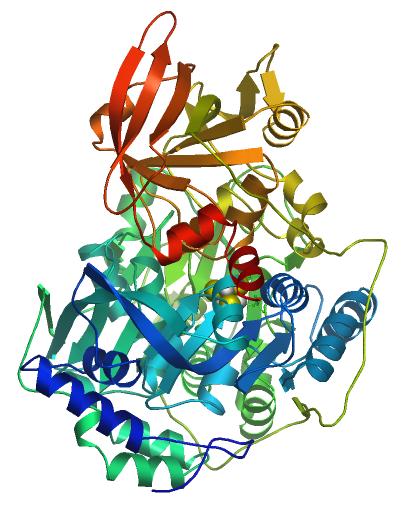
The box contains a picture of the protein. I want to show you a similar, larger picture from another database of the aconitate hydratase protein as they use it in models. The last picture here (image 4) is from Swiss Model Repository, entry Q99798. Swiss Model Repository is a database that shows the 3 dimensional models of proteins. The swirls and arrows show the types of folds that the amino acids make in order to form the protein so it does a specific job. This protein is made up of 780 amino acids which must be in a particular order (if you are interested in more details of the protein, you can get them at yet another database, Uniprot, entry Q99798). At the bottom of the third picture, there is a list of amino acids that make up the enzyme that we are talking about. (For information on amino acids, go to CreationWiki HERE.)  For purposes of saving space, I did not add the bottom section of the box, which lists the specific order of the DNA of the protein's gene.

If you have gotten this far, I appreciate that you have been interested enough to read about the complexity of cell biology. It is important because of what I’ve been talking about concerning the question of neo-Darwinian evolution and whether it actually happened. Though you may hear some scientists or their spokespersons say evolution is a fact, the possibility and reality of it is something you have to decide for yourself.

Thursday, January 24, 2013

Cell Biology

When you start learning biology, there are new terms. With computers, your job, and/or your school, you learn new things all the time, so you are already acquainted with the activity. So I hope you will be open to learning about cell biology. It is a fascinating subject, and well worth the time. Perhaps you already know biology, but I hope you will still look at what I have here.

There are an estimated 75 trillion cells in the human body (and trillions of atoms in each cell). From bacteria to humans the cell is the basic unit of biology, and its activities are called “metabolism.” The cell absorbs and stores food, then breaks it down and converts it into energy. It uses energy to reproduce DNA (genes) and assemble proteins among other things. The DNA is used as a code for the proteins  which in turn do the work of the cell and the body. For example, your muscles have muscle cells which contain muscle proteins that contract and relax. They are called by specific terms, but we don’t have to name everything to get the overall perspective.

One of the basic parts of the ongoing process of metabolism is where several groups of proteins are embedded in a membrane of of the cell. The membranes are in folds, and in humans the folds are parts of what are called mitochondria (mite-oh-CON-dree-ah). First I have a short video (less than 4 minutes) for you to see how one of the groups works to form the energy molecule called ATP. ATP has chemical qualities that give it the ability to use a chemical bond for activity needed in the cell as I described above. It changes to ADP when used up, then is re-cycled back to ATP by this complex. You may hear some terms you don’t understand, but just try to get the concept of this series of steps going on in most of your body’s cells.

The video is done by North Dakota State University which has done other animations you can see HERE if you want to learn more. As interesting as the above video is, the protein complexes are drawn rather simply. Below is a more detailed picture of a series of complexes needed to make the last one, ATP Synthase (SIN-thase), work. They are needed to produce the electrical gradient which is described in the video. The mitochondrial membrane is pictured between the complexes, with ATP Synthase at the far right.

The image (link HERE) comes from a database called Kyoto Encyclopedia of Genes and Genomes (KEGG). The boxes in the picture give information for various parts of the complex when you click on them at the KEGG website.

Now, please stick with me a little longer to get more of the perspective of how complicated this series is. In the picture, the last group of proteins on the right is ATP Synthase. On the bottom part, there are blue-colored sections. The darker blue have a β on them for beta subunit (beta is Greek for “B”). Proteins are made of yet smaller units called amino acids (ah-ME-no acids, Wikipedia entry HERE). These are repeating groups of atoms, including carbon, oxygen, nitrogen and hydrogen (C, O, N and H). Here is a picture of one of the 20 types of amino acids found in biology, called alanine (AL-ah-neen):

Carbon is also understood to be in the angles of the molecule image. The types of amino acids need to be in correct order, according to their size, electrical charge and other factors, so the proteins can fold into the shapes in which they function. It is similar to machine parts which need to have the right shapes to fit and move together. Now I have just one more picture. It is the list of amino acids in this one part of the whole complex, the beta (B) subunit of ATP Synthase as pictured above. This particular one (human) has 529 amino acids, as listed in another database called Uniprot, entry P06576. Each letter stands for an amino acid, such as A for alanine (letters can stand for different things depending on their context):


All the proteins parts of this entire complex are made of various arrangements of the amino acids. Many are at least 100 amino acids and some are many more, as you have seen. These need to be constructed and put together within most of the cells that we have. There are many such complexes within each cell.

Thank you for bearing with me to learn about this part of cell metabolism. Remember, this is only a very small fraction of the complexity in the cells. Even small organisms need energy systems such as these to put together their own genes and proteins. Please think about whether this could have come about by chance, no matter what the time frame. After all, a computer would not form on its own, no matter how many billions years pass, and that is not nearly as complicated as we are.