Showing posts with label Spliceosome. Show all posts

Friday, August 1, 2008

Introns

It's an exciting time in biology. New knowledge is coming forth and reported in scientific articles. And, what's more, many do not support totally materialistic, naturalistic evolution (total-natural evolution). The authors of these articles, however, may not be willing to agree that their findings do not support Darwin. On one hand, we should realize that a huge amount of new information has become available from microbiological research and more will be coming. Many scientists look to the future for confirmation of materialistic evolution. On the other hand, scientists should be willing to express where we stand now. And when you look at the math, total Darwin doesn't add up.

One of these articles (don't give up--you don't have to understand the jargon) is by Csürös, Rogozin and Koonin, "Extremely Intron-Rich Genes in the Alveolate Ancestors Inferred with a Flexible Maximum-Likelihood Approach," Molecular Biology and Evolution 25, 5 (Online Feb. 21, 2008): 903-911. You can link to the article abstract by clicking on the title.

To understand the significance, you need to know that there are different types of cells. Two major types are Prokaryotes and Eukaryotes. Eukaryotes (pronounced you-carry-oats) are the cells humans and multi-celled animals have. Prokaryotes (pro-carry-oats) are the type that many (not all) single-celled organisms have, such as bacteria. There is much more detail about the differences at Wikipedia under Cell (biology) HERE . A few of the differences are: 1) DNA in the eukaryote is structured and divides differently than the prokaryote; 2) the eukaryote has a type of skeleton in the cell but not the prokaryote; 3) the eukaryote has INTRONS and the prokaryote does not. The introns are what I have been talking about in the last few posts. They are "extra" parts of the DNA which are copied to RNA and are removed before RNA makes the protein. You can see the mechnism and parts needed for it in the previous posts (scroll or click spliceosome link below).

So the research reported by the article above was to use mathematical tools to find out how many introns were in the ancestors of selected living eukaryotes. The abstract, or short description of the paper, admits that the outcome was unexpected. The ancestors of several subgroups of organisms they studied had much higher levels of introns than one might predict if one expected Darwinian evolution. In fact, one subgroup had a higher intron density than humans!

Now, look at my previous entries about spliceosomes (you can click HERE to see them or on the spliceosome label at the bottom of the post). These show that five spliceosomes are used in the splicing process to remove introns. There has to be genetic codes in DNA to make each of the RNA-protein units (U1, U2, U4-6). The units also must have work done to form them into the shapes they need to do specific jobs (just like hammers and screwdrivers need to be certain shapes to do their jobs).

Not all the structures of proteins have yet been worked out. But below is an image from Swiss Model Repository of a protein molecule that changes RNA structure, called a pseudouridine synthase. It is from an organism known as Pseudomonas aeruginosa. It works on a different RNA, called tRNA, but it gives you an idea of the type of molecule needed to change the shapes of RNA into what you have seen on my posts about spliceosomes. (I have added the link to ExPASy HERE. When you get to that page, you can access Swiss Model Repository which computes these models.)
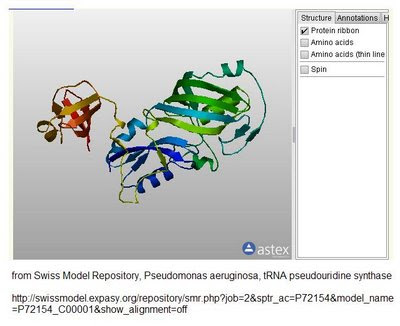


The findings in the article to me imply that the ancestors of eukaryotes must have had these complex mechanisms from the start. The theory that these cells and the bacterial prokaryote cells had a common ancestor is wearing thin. As Hugh Ross and others have explained, findings in geology have shown that not much time lapsed between the cooling of the earth and the start of biological life. The spliceosomes and the DNA and proteins needed to form them have thousands of atoms in specific positions to allow them to do specific activities. These atoms have astronomical numbers of potential combinations, but only extremely rare combinations will work. As I said, it's an exciting time in biology.

Tuesday, July 29, 2008

Spliceosomes U4-U6

I'm catching up from weekend guests, so I'll just show you the rest of the major spliceosomes today and comment on the whole process next post. They complete the set which carries out the process of intron removal in RNA, which you can see in previous posts (spliceosome label at bottom of post).


Friday, July 25, 2008

Spliceosome U2


The DNA of a cell must be copied to RNA and that in turn is eventually used to create proteins. The RNA in a "true" cell, or eukaryote, is often edited before it becomes the template for the proteins. I showed the first part of this process and gave some background in a post a few weeks ago which you can see HERE. By the way, the picture here is only partial and shows the "major" but not the "minor" splicing mechanism. You can see that by going to Wikipeida HERE.

Some areas are removed before it goes on to produce protein (the editing part). There are five molecules which take part in the regular splicing activity (a different set occurs in some reactions, but I will not go into that). I showed the first part of the splicing process and the U1 molecule in the first post. The top picture today shows the rest of the splicing reaction and the picture below shows the U2 RNA molecule (Wikipedia HERE).

Sunday, June 29, 2008

Spliceosome U1


For an organism to make proteins necessary for life, the genes in DNA are copied to mRNA (the m before RNA stands for messinger, since there are different kinds of RNA) by a protein called RNA polymerase which I showed in a picture and previously described HERE. Once the mRNA is copied, it needs to be modified or "edited" because, for some reason not yet understood, there are unused parts between the usable parts of the gene. There are a group of special molecules which do this work called "spliceosomes." They consist of a combination of RNA and proteins. The pictures here show the beginning of the process and the first spliceosome. The ends labeled exon 1 & 2 are usable parts of the RNA that will remain, while the middle unused part, called the intron, will be removed by the molecules. The picture above is a detail of an image on Wikipedia under the heading, minor spliceosome.


The picture on the right is the first spliceosome to find a place on the RNA, called U1. The letters making up the structure (G, U, A, & C) stand for the set of molecules (made of atoms) that make up RNA--guanine, uricil, adenine, and cytosine. You can link to Wikipedia to see guanine or to my post HERE to see them all (update 2008/08). The U1 unit connects with mRNA and starts the processes needed to remove the intron. These actions are present in life in cells known as eukaryotes, which you can read about in Wikipedia HERE. They are not in prokaryotes. This means this whole set of metabolic activities would have had to develop by chance, along with many other new processes in the eukaryote, if total materialistic, naturalistic (total-natural) evolution is true.
~ ~ ~ ~ ~ ~ ~ ~ ~ ~
Update May 20, 2014: I've put in several places that I've changed from advocating Intelligent Design Theory to Direct Supernatural Creationism. I sometimes call totally materialistic, naturalistic explanations "total-natural" in contrast to "supernatural," a word already understood.