Showing posts with label Proteins. Show all posts

Tuesday, July 7, 2020

Type III Secretion System

Some bacteria use "secretion systems" (SS) to do various things: they help humans digest food, they are capable of horizontal gene transfer, and some use them to inject toxins into their victims. There are different types, and I had described two of them, Type II SS and IV, in a previous post HERE. Since the beginning of gene sequencing in the 1990s, scientists are becoming aware that not all genes are following the expected Darwinian tree. So they used horizontal gene transfer as their explanation: some genes went to different species under different conditions than the strict mutation and natural selection model that Darwin proposed. I also discussed that in the post mentioned above.

But the Type III secretion system (T3SS) itself has been used as a possible structure that could be a Darwinian source for the bacterial flagellum, a tiny biological tail with a motor that is used as a model of design by the Intelligent Design movement. I would like to describe this T3SS to add to the previous information I have on Types II and IV.

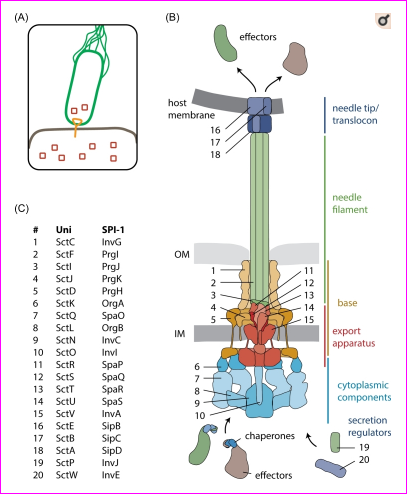
I’ll start with an overall image of one which is from the article: S. Wagner et al., “Bacterialtype III secretion systems: a complex device for the delivery of bacterialeffector proteins into eukaryotic host cells,” FEMS Microbiology Letters 365, 19 (Aug. 9, 2018). FEMS stands for Federation of European Microbiological Societies. I'll call this the Wagner image.

(This is an Open Access article distributed under the terms of the Creative Commons Attribution-NonCommercial-NoDerivs licence 4.0 International.)


The drawing at top left (A) shows the bacteria using the T3SS to inject toxin into its victim. The system with number keys (B) is at right. The numbers label the protein components of the system. The lists at lower left (C) are two separate protein labeling systems for the T3SS. More details can be found at the article link given above.

As you can see, 20 different proteins are listed for this general depiction of the T3SS. Some are used multiple times.

More detailed looks at the needle complex are shown at the Research Collaboratory for Structural Bioinformatics Protein Data Bank (RCSB) entry 6Q15. These are based on an article from J Hu et al., "T3S injectisome needle complex structures in four distinct states reveal the basis of membrane coupling and assembly," Nature Microbiology 4, 11 (Nov. 2019): 2010-2019. The abstract is at the same web page given for the image (link at entry number). A side look:


The proteins interact with both the same and different proteins to form working structures. In the needle complex structure pictured above, the webpage lists 8 of the 20 proteins pictured in the Wagner image. Details of each are given, such as the number of amino acids per protein and depictions of the proteins isolated from each other. The first one listed, PrgK (number 4 on the Wagner image), has 252 amino acids. The second, PrgH (no. 5 on Wagner), has 392. The third, InvG (no. 1 on Wagner), has 562. The other counts of amino acids in this group of 8 range from 80 to 263.

And part of a base from another angle at RCSB 6PEM (same article citation as above is at this webpage, although this webpage lists only 6 proteins):


At the website, these images can be manipulated in 3D. Hit the 3D View Structure link below the image.

Though I've had images before in this blog of the 20 biological amino acids, I'll show a chart here. They join together in a specific chemical formation to make the various proteins of our bodies.


These subunits must have the right shapes and charges in the right places for the T3SS to work. The system also requires energy from the respiration of the cell, an extremely complex system in its own right. It takes DNA and separate proteins to make these proteins and the bacterial cells must conduct other life-sustaining metabolism in the meantime.

A last image shows even more of a close-up of a protein in the T3SS, called SipD, which is needed for the invasion of other cells (in the Wagner image it is #18). A chain has 346 amino acids, but several chains combine for the whole protein. The image comes from the article, M Lunelli et al., “Crystal Structure of Prgi-Sipd: Insight Into a Secretion Competent State of the Type Three Secretion System Needle Tip and its Interaction with Host Ligands,” PLOS Pathogens 7, 8 (Aug. 2011): e1002163. More information is at RCSB, entry 2YM9:


Citation for RCSB: Helen M. Berman, John Westbrook, Zukang Feng, Gary Gilliland, T. N. Bhat, Helge Weissig, Ilya N. Shindyalov, Philip E. Bourne, "TheProtein Data Bank," Nucleic Acids Research 28, 1 (Jan. 1, 2000): 235–242.

As stated before, the T3SS is used as an example of a source for the bacterial flagellum, but it is described in authentic scientific literature as a complex system itself. Complex systems are found throughout all life and needed for survival. Together, they have almost countless atoms working in fabulous harmony. Where is their source?

Though Intelligent Design Theory technically defines the term "complexity" in relation to computer language, we do not have to be computer experts to understand the familiar meaning of the word "complex." People who believe God directly formed life can easily cite Romans 1:20, written by the Apostle Paul, "Ever since the creation of the world, his invisible attributes of eternal power and divinity have been able to be understood and perceived in what he has made…" (NABRE).

We all know about Galileo and the shifts of assumptions after discovery of planetary moons. But in the same way humanity was surprised because of what we learned in the scientific discipline of astronomy, we may well be even more surprised by biology. Many think a paradigm shift away from God came through reason, but the way back to God is even more logical if we cleanse ourselves of false premises. Let us not be afraid of dire "God of the Gaps" warnings. Of Jesus Christ, Paul said, “For in him were created all things in heaven and on earth…all things were created through him and for him” (Col. 1:16). Have faith that the more we discover, the more our knowledge will point us to appreciate all of God's handiwork.

Wednesday, October 16, 2019

Important Research

Many people seem swayed to believe in totally materialistic evolution for various reasons. But if you are going to be "scientific," you have to be willing to look at all the evidence. What many are missing are the huge differences in the species that greatly overwhelm the similarities.

It has been 30 years since a very significant scientific article about proteins was published by researchers. One of the scientists is Robert T. Sauer, Salvador E. Luria Professor of Biology at MIT. He has a BA from Amherst in biophysics and a PhD from Harvard. The paper and the findings are technical, but I will attempt to explain, so I hope you will try to read through. The paper is by JF Reidhaar-Olson and RT Sauer, "Functionally acceptable substitutions in two alpha-helical regions of lambda repressor," Proteins, 7, 4 (1990): 306-16. From here I will refer to the article as RO&S, and the abstract can be found in the paper title link at the NCBI PubMed website. NCBI stands for National Center for Biotechnology Information.

The Lambda phage is a virus that infects bacteria, in this case E. coli., and it has a protein called repressor. I have included an image of repressor (purple) next to a DNA strand, from Research Collaboratory for Structural Bioinformatics Protein Data Bank (RCSB PDB). More information on this protein is at RCSB PDB entry 3BDN.  Citation for RCSB PDB: Helen M. Berman, John Westbrook, Zukang Feng, Gary Gilliland, T. N. Bhat, Helge Weissig, Ilya N. Shindyalov, Philip E. Bourne, "The Protein Data Bank," Nucleic Acids Research 28, 1 (Jan. 1, 2000): 235–242.

Proteins are made within the cell, the basic unit of biology, of every living organism. DNA codes for proteins, which do much of the work of the specific cells. The alpha helical regions to which the RO&S paper refer are among the particular parts of proteins that give them their function. The lambda repressor was the protein they were researching, although they used just part of the protein for the experiments. The substitutions in the title refer to the subunits of proteins, called amino acids. There are 20 kinds of these in most proteins and each is made of a certain set of atoms. The researchers wanted to see how many amino acids could be interchanged with the parts of the protein still remaining functional. They used an experimental method to make random substitutions in these subunits within the repressor protein. The amino acids are numbered and they used two sets: 8-23 and 75-83 (Using 1-92 amino acids of a 237 amino acid protein).

I will use the term "permutation" here, meaning the evaluation of proteins must include specific order of amino acids and their repetition, unlike "combination" which does not require a specific order. (I am saying here, though will elaborate in another post, protein probabilities are not evaluated like card games.) RO&S reveals that though there are a large number of subunit permutations which can make working protein folds similar to the particular one they studied, the proportion of functional ones of possible permutations are only about 1 in 10^63. 10^63 is the number 1 with 63 0's following it. (I like to use a caret ^ when writing what are called exponents because it is easier but (for example in this case) the number can be written 1063 . The first or lower number is the base and the second or upper one is the exponent. The exponent tells you how many times to multiply the base times itself to get to the final number it describes.)  1 in 10^63 is a very, very small proportion of permutations that work. Relating to evolution, the less proportion of functional choices there are, the less the probability you will get one to form by chance. There has to be something to choose from (coming from mutations) in order to get any selection!

The authors of the RO&S paper claim the gist of this research was supposed to show the admittedly large number of possibilities for the amino acid subunit combinations to make protein folds (the term “degeneracy” they speak about in abstract). However, the paper showed something way more significant, the proportion of non-functional to functional as already described. To give the researchers credit, they do talk about the limitations of content of proteins in the abstract, but not the specific findings. A reader has to follow the paper to the second last paragraph of the article to find it, and the paper is behind a paywall!

If you are at all interested in reading the whole RO&S article, the abstract page from my link has a link you can follow to get access to the paper. But it is through Readcube and there is a charge and as far as I know you can't get it free online. If anyone knows it is available online, please let me know. However, I got my copy of the entire paper through inter-library loan for free a few years ago. Inter-library loan is still available, although I don’t know if it always provides the whole paper. Or, you may live close to a University which allows access to their journals. I was able to read several other articles in this way. Fortunately, there are some research articles which are available online in complete form, and I have an important one here with a link (Fredric P. Nelson) which I discuss below.


Another significant fact about the RO&S research was that, although they used different methods than some theoretical work done earlier by Hubert Yockey who applied Information Theory, their work closely backed his. Yockey's research was done in the 1970s and gave indications then that proteins are very rare. I have a previous post about this work. He used a protein involved in respiration, Cytochrome C, and compared it in different species. An image of it is included here from Uniprot entry P99999. Citation for Uniprot is Uniprot Consortium, "UniProt: a worldwide hub of protein knowledge," Nucleic Acids Research 47, D1 (Jan. 8, 2019): D506-D515.

A link is here to the abstract of the paper by Hubert P. Yockey, "A calculation of the probability of spontaneous biogenesis by information theory," Journal of Theoretical Biology 67, 3 (August 7, 1977): 377-398. He included a few more chemical factors and estimated a chance in the range of 1 in 10^65 for nature to select a Cytochrome C sequence randomly.

Then other experiments were done and numbers proved to be again similar. An important scientist has researched at University of Cambridge. The Abstract in one of his papers is from Douglas Axe, "Estimating the Prevalence of Protein Sequences Adopting Functional Enzyme Folds," Journal of Molecular Biology 341, 5 (Aug 27, 2004): 1295-1315. It shows a 1 in 10^64 proportion for a low-function domain and 1 in 10^77 for overall short protein function. Perhaps a general number of 1 in 10^70 could be used for simple proteins, but many are much more complex and therefore would be even more rare. The numbers compare to 10^65 atoms in our galaxy to 1^90 particles in the universe.

The Darwinian claim is to take the fact that DNA randomly mutates (or changes) as time goes by and conclude that the resulting proteins, which are a little different from previous ones, will lead to new species. The fittest, or best, of these changes in particular individuals allows them to survive and leads to fitter organisms.  Evolutionists say the 4 billion years of the Earth's habitable environment allowed for enough changes for humans to emerge. But organisms change only a little at a time. Bacteria do not even have one change per generation.

There may be some small, natural neo-Darwinian evolution in life, but there are other considerations. We must include large differences between some proteins as well as small ones. Some resemble each other and are functional and may have come from random mutations of DNA down the generations. Maybe even a protein that is slightly broken from a mutation may stop an antibiotic from binding to a bacteria's wall thereby making it resistant to the antibiotic. But there are many critically necessary proteins that are not even close to others in terms of their subunit arrangements and could never have evolved one from another, in a Darwinian sense, even in four billion years.

Fredric P. Nelson calculated the maximum number of organisms that could have existed on the Earth by water volume in 4 billion years at about 10^50. You would not have enough organisms in 4 billion years to try for proteins that are only available at the rate of 1 in 10^70. Fortunately, this whole paper is available online. Page 31 and the footnotes are especially interesting since his calculations are there. The link is here for Fredric P. Nelson, “Needed: A New Vocabulary for Understanding Evolution,”  Perspectives on Science and Christian Faith 58, 1 (March 2006): 28-36.

We need to look at a few more discoveries. As scientists discover the DNA (and thereby protein) codes of more and more species, they are finding a certain percentage of each, around 10% to 30%, are not related to any other species. These as a group are known, among other names, as orphan, or ORFan genes (a gene being defined as a protein-coding part of the DNA chain). Among the many scientific papers that have been reporting this finding is by Arendsee, Li, and Wurtele, "Coming of age: orphan genes in plants," Trends in Plant Science 19, 11 (Nov. 2014): 698-708. This finding is related to the limit of numbers of organisms that have been available to mutate for "tries" for functional proteins just mentioned.

Concerning life's origin, a minimal, natural free-living organism (not a lab creature which is given nutrients) has been estimated to need around 1000 proteins to survive by NCBI researchers Koonin and Wolf, "Geneomics of bacteria and archaea: the emerging dynamic view of the prokaryotic world," Nucleic Acids Research 36, 21 (Dec. 2008): 6688-6719. Even if some were closely related, the independent probability of only 10%, or 100, functional proteins is about 1 in 10^7,000. 

Pertaining to both origin and evolution, N. Tokuriki and D. Tawfik researched protein stability in terms of thermodynamics and kinetics. They found only a few substitutions could be tolerated before the proteins became severely impeded in their function. Though there can be compensation, this severely limits any ease of evolution. The article is N. Tokuriki and D. Tawfik, "Stability effects of mutations and protein evolvability," Current Opinion in Structural Biology 19, 5 (Oct. 2009): 596-604.

So no, these numbers are not wiped away by the Darwinian duo of random mutation and selection of the fittest. We must keep in mind that for evolution,  the first step, random mutation, must happen first inside the organisms in their reproductive cells in order to form any new proteins that could be selected. This vast improbability of functional proteins overwhelms even the number of organisms that existed on Earth. No mutation rate could bring about new proteins on a viable level.

Also, I don't believe quantum physics either explains or explains away proteins. QP is real and admittedly very strange, but chemistry is also real and is described by its own physical rules. If that were not true, we'd all be constantly slipping in and out of reality (granted, some think this is exactly what happens).

The rarity of functional protein folds is one of the features that convinced a well-known Yale computer expert and professor to recently exclaim Darwin’s theory proven false. His essay is David Gelernter, "Giving up Darwin," Claremont Review of Books, XIX, 2 (Spring 2019): 104-109.

There are admittedly many, many things to learn about proteins and DNA. That is important for creationists to keep in mind. However, for scientists to insist on totally naturalistic evolution by random chance, they deny what is true once again. In Darwin's day, they said the cells were blobs which had little to no internal activity. Then scientists denied DNA and proteins were rare due to specificity, which is proving to be wrong. They claimed DNA was filled with junk which is now being revealed as useful. All their false concepts delay scientific progress, yet they claim the creationists are the ones who are detrimental to it. Thankfully there are individuals who do not stop investigating when the consensus resists change. 

One book about Catholics and evolution is by Fr. Michael Chaberek, OP, Aquinas and Evolution (Chartwell Press, 2007). Chaberek asserts that at the end of the nineteenth century, "Thomists universally rejected the Darwinian theory of origins" (p. 10). He lays out his thesis that Aquinas was not an evolutionist and today's science would not change his mind. In the Forward to the book, Logan Gage, PhD, Chair of the Philosophy Dept. at Franciscan University of Steubenville, writes, "Culturally it has been easy to dismiss worries about Darwinian evolution as a 'fundamentalists' Protestant problem. Additionally, we Catholics have a 'Galileo Complex.'"

Some Christians insist that God would only create life in a certain materialistic way. I remind everyone that God does as He sees fit, and many Christians look at the living wonders of the world and think God made at least some of them in original species through Special Creation. New scientific discoveries are actually supporting our view.

For us, science is the study of created physical things. We need to show the world it is not only reasonable to be a believer, it adds the vital meaning to our lives. Let us praise the Lord, through Jesus Christ, for His Creation.

Monday, March 14, 2016

Protein Levels


Proteins do much of the work of the cell, the basic biological unit. Proteins are made of sub-units called amino acids, which in turn are made of atoms.

There are thousands of different kinds of proteins. I have posted previously about a set of proteins that work together, called ATP Synthase (ATPS, pronounced ATP sin-thase). The set acts together in this energy production machine. All organisms have ATPS (with the exception of viruses which are parasites and so benefit from ATPS indirectly).

Though I have pictures of ATPS elsewhere, I am putting this picture in my blog because it shows in one view the detail from three levels. The one on the upper left is the whole machine, a picture by David Goodsell at PDB-101 Molecule of the Month, under ATP Synthase HERE.

One of the proteins of ATP Synthase is circled and an arrow points to the box to the right. It shows the makeup of the amino acids in just one part of the machine (represented by their single letter symbols). The sequence for E. coli bacteria can be found at protein database Uniprot entry P0ABB4. As you can see, it is made up of 460 amino acids which have to be in correct order for the ATPS machine to work. (For humans the entry is P06576. Though the number of amino acids is different in humans from E. coli, they still have to be in an arrangement that is functional.) The next box to the left is an image of the atomic arrangement of one amino acid (atoms are represented by their own letters which can be determined by the context).

If you are interested, you can see in a video at a previous post HERE how ATPS operates when protons flow through it because of an electrochemical gradient. The video lasts less than 4 minutes. The molecule that it makes is called ATP, or adenosine triphosphate (ah-den-oh-seen try-fos-fate). This molecule is used to make proteins and DNA among other uses. Here is a picture of it:


Beyond the ATPS, other molecules are needed to set up the proton gradient that makes it work (seen at the same link HERE).

Some proteins can handle a few changes of amino acids, but some positions can't be changed or the protein will not work.

These proteins did not come about by chance, even in billions of years.

Friday, October 3, 2014

A Matter of Faith

This month a movie that comes out on October 17 and will be showing in Grand Rapids is A Matter of Faith (Five & Two Pictures, Cristiano Film Group, 2014) which I’ll abbreviate AMOF. In it, a young woman attends college and is influenced away from faith by her evolutionist biology professor. Her father becomes upset and ends up debating the professor.

I heard a producer of the film being interviewed on a Christian radio show I listen to on Saturday mornings, and I looked the movie up on the Internet. I found the website and played the trailer (at the link on the movie's name above). To my surprise, I saw the campus of one of my alma maters—Aquinas College in Grand Rapids! I did a search and found the co-producers, the Christiano brothers of Christiano Film Group, are from Grand Rapids and the production was headquartered at Cornerstone College which is located on the East Belt Line there. Scenes were indeed taken from Grand Rapids locations including Aquinas. These facts and more were reported by Terry DeBoer in "Feature film 'A Matter of Faith' continues filming in Grand Rapids...," MLive, June 24, 2013.

I attended Aquinas College for a certificate in theology, which I received after 18 credit hours. I had already earned a veterinary degree, but have been interested in theology and spirituality for a long time. Then, around the time I was going at Aquinas, I started reading the works of Intelligent Design (ID) advocates such as Michael Behe (Darwin’s Black Box), William Dembski  (Intelligent Design) and Phillip Johnson (Darwin on Trial). I already was convinced that biological life was not a product of totally natural evolution, but I enjoyed reading their works and learning more about the controversy.

I didn’t agree, though, with the Intelligent Design advocates in their approach to science. They wanted to prove design in a strictly scientific way, but I think that faith comes first. Of course, not everyone believes. But, IF a person believes in God, THEN s/he believes all things are Created and therefore all things are designed. You don’t prove design, you believe it. However, if you want to look at the scientific part of why totally natural evolution should not be considered feasible with the knowledge of natural laws as they are now, it’s as simple as this: the complexity of biology defies probabilities.

I wish I had bookmarked a conversation I saw recently, I’m pretty sure from Evolution News, between an ID advocate and an evolutionist. I can’t find the article now, but the background is that, as scientists compare the proteins of different species, they try to match the sequences of their sub-units. If they match, the scientists say it proves that one species came from another. As I remember, the ID advocate, who wrote the article, asked how evolutionists can think that the low probability of matching protein sub-units in various species proves evolution whereas the overall probability of the proteins existing in the first place is much smaller by far. The evolutionist said something like: the comparison of proteins gives scientists frames of reference, but the origin has no frame of reference. Apparently chemistry, physics and mathematics don’t count as frames of reference when it comes to origin of life and new proteins along the way of species differentiation. Actually, the experimentally proven extreme rarity of functional proteins among all the combinations of their sub-units (amino acids) provides a very fundamental frame of reference. (The evolutionist also did not explain why the differences in proteins do not count in the determination of proof but only the similarities.)

The comparison of proteins can be accessed on the Internet in various databases. The UniRef database is from the UniProt consortium, which is a combination of particular European and American protein database providers. UniRef shows relationships between proteins in over 200,000 species. The species are classified by "taxonomy," and the National Center for Biotechnology Information (NCBI) home web page for this database is HERE. This is about 10% of all formally described species. They identify each protein and give it a cluster identification, then compare proteins to different species. If the proteins are similar, they are put together in a category of "cluster members." The charts on the database give the number of clusters that compare closely to others, along with the species names. And yet as of October 3, 2014, there are more than 7,750,000 single clusters of proteins that match less than 50% to other clusters out of a total of around 82,000,000 clusters. (2020 Update: it appears now that if there are no matches the protein is called 100% match with itself in a cluster of 1 member. An example, UniRef100_A0A001)

I took one of the clusters (UniRef entry M0E4M2) and looked a little more closely at it. There were several species in this cluster, but the group for the "cluster" were still close cousins. The protein is called “histidine kinase” (UniProt entry M0E4M2) and it is in the organism "Halorubrum saccharovorum," part of a family of archaea (pronounced are-KEY-ah). Archaea are single-celled organisms that were first thought to be ancestors of bacteria, but were found to not be related once the genes could be sequenced (starting in the mid-nineties). So this particular protein structure is so far only found in one family of one type of organism. The protein is involved in sending molecular-level signals. (Histidine is an amino acid, Wikipedia entry HERE, and a kinase is an enzyme, Wikipedia HERE).

It can be hard to get an image of a specific protein since there are so many proteins--not all have been depicted. I apologize that I have not been able to find an image of this particular one, but think I am still able to demonstrate how different proteins can look and how different their structures are. The first image is from an Archaea species, Methanocaldococcus jannaschii, of a kinase that has histidine as an active site. It is called Isopentenyl phosphate kinase, UniProt entry Q60352. The explanation of the protein is at RCSB PDB entry 3K4O.

The second image has a histidine kinase (UniProt  (Q9WZV7) from a different species known as Thermotoga maritima. This is a bacteria instead of an archaea. When the sub-units (20 different amino acids) of the Halorubrum and Thermotoga proteins are compared, the identity is figured by the ALIGN program in UniProt to be 14.2%. When I run the two proteins pictured here, from Methanocaldococcus and Thermotoga, against each other, the identity is less than 10%. And even the two Archaea proteins, from Halorubrum and Methanocaldococcus, matched only at 9.9% . You can run the Align yourself if you want by using the UniProt ID numbers of the proteins: Q9WZV7 for Thermotoga, Q60352 for Methanocaldococcus, and M0E4M2 for Halorubrum. Though they have different lengths, all with hundreds of amino acids, the matches are very minimal for any of the sections.

Some say that instead of individual amino acids, larger sections of various proteins might have randomly combined, and often you hear there is “horizontal transfer” from one species to another. But horizontal transfer depends on about 30 specific proteins, and besides the improbability of them forming in the first place, not all organisms can do this transfer. And once you get above single-celled organisms, the chances are even smaller because the transfer would have to involve the specific reproductive cells.

Even though there is a big variety of molecules throughout living systems that do similar things, this doesn't mean every protein can do every job. Just like in factories, the thousands of specialized jobs need specialized tools to do them. Or think of cars, trains and planes. Each of them are used for transportation, but you don't use car parts for a train, and train parts do not have intermediates for plane parts. Each part is made specifically for its purpose. To take the analogy a little further, there are different kinds of cars, trains and planes, and though some parts may interchange among the various types of each, many can't.

In naming clusters, UniRef compares proteins and the manual says it looks for 80% match. However, in the UniProt "Align" section, the comparison of proteins described above shows you how well short fragments match. When you get very low matches, this minimizes the idea of functional sections from different proteins somehow finding each other, at least so far. It is becoming known that about 10% to 20% of proteins of every living organism are ORFans, or those which have statistically little to do with each other (see my booklet, Creation Biology). And millions of fragments would have to unite at the exact junctures to become functional within the limit of 10^50 organisms that could have existed in 4 billion years on Earth.

All Christians should consider themselves Creationists because, as it says in our creeds, we believe God made all things, visible and invisible. Unfortunately in today’s academic atmosphere, even Christian colleges are blocking the attempts by certain Creationists called Special Creationists to make their cases. Special Creationism is a belief that God made humans and “kinds” (similar to species) directly without long-term evolution. Many Fundamentalists are Young Earth Creationists, but one can be open-minded about the age of the Earth and still believe people were created directly, in a way that they did not stem from other species.

Even Theistic Creationists, who are supposed to believe that God intervened along the way of long-term evolution, don’t seem to want to talk about the supernatural part. Many from their main think tank at Biologos seem to insist that evolution is totally materialistic and at bottom a random process.

The situation is worse in secular colleges, where the mere mention of supernatural biological Creation by God brings condemnation. But it is a shame that the Christian universities are almost as bad. From the overall situation comes the movie AMOF which, as said above, involves a college student who is being taught evolution by her biology professor. Her father is fearful she will lose her faith altogether which is why he debates the professor.

The AMOF movie does not have the wide distribution of “God’s Not Dead,” but the movie conveys very real problems felt in the Catholic world. The Catholic philosophy of “Thomism” in which St. Thomas Aquinas, the great scholar of the 13th century set out to blend faith and reason, is very complex. But to address one point, I have heard it said in the name of Aquinas that God created the universe in a way that all things were laid out in order and that He would never contradict that natural order by intervening in a supernatural way once it was laid out.

A problem in Thomas' time was that the Greek philosophy had recently become available to European minds through its translation into Latin. And for one thing, there was an apparent conflict between this “Reason” and “Faith” over the source of the universe and its contents because the Greeks (such as Parmenides) had said “Nothing comes from nothing.” Christians believe that God made the Universe from nothing. So Aquinas held that though things are usually made from other things, there must be a “First Mover” and a “First Cause.” But he also specifically commented about the creation of humans.

In Summa Theologica, Part I, Question 92, Article 4, Thomas Aquinas says this in his answer (after laying out the contrary argument [objection] first, which is at the New Advent link HERE if you want to read it):
As was said above…the natural generation of every species is from some determinate matter. Now the matter whence man is naturally begotten is the human semen of man or woman.  Wherefore from any other matter an individual of the human species cannot naturally be generated.  Now God alone, the Author of nature, can produce an effect into existence outside the ordinary course of nature.  Therefore God alone could produce either a man from the slime of the earth, or a woman from the rib of man.
 In the next statement, Reply to Objection 1, Aquinas says: 
This argument is verified when an individual is begotten, by natural generation, from that which is like it in the same species.
 Darwin’s Theory of Evolution was causing problems for the Church, but there was philosophical upheaval before then. In 1879, Pope Leo XIII put out an encyclical called Aeterni Patris. He said that science is good, but it needs to be combined with faith, and used St. Thomas Aquinas as the ultimate model in the combination of the two.

I'll never know all the in's and out's of philosophy and theology. I do perceive we've gotten to the point where anyone who argues against neo-Darwinian theory is considered either an anti-science Fundamentalist or an anti-reason, anti-"form"ist. We are treated in a hostile manner by many Catholics as well as atheists. Well, the complexity of biology is showing that the Fundamentalists may just be right after all.

It is a little risky to speculate on what God would or wouldn’t do. Some think He’d never “trick” them by making genes “look like” they have mutated over time when they really hadn’t, such as they say is the case with Vitamin C gene. However, the Fundamentalists have long associated imperfect (fallen) nature to original sin. In fact, it would be contrary to our doctrine if nature were still perfect. But I’ve never heard this aspect discussed by the detractors.

We are left with the question of whether God created species or kinds in increments, with parents of different characteristics. Though Darwin claimed it was a slow process, in the intervening years we have found the difference in body make-ups between parent and child would have to be pretty big in some cases. Can the parent bug give birth to a fish-type child?  (I'm exaggerating, but only a little.) The body type comes from the egg as well as the DNA, so the egg would have to have major changes from within the parent. I’ve never heard any proposal of scientific-supernatural solutions for these problems from Theistic Evolutionists. Maybe I’ve just missed them, but I doubt it.

I used to accept that people come from apes, but I don’t anymore. People were made by God, and I think He did it directly and supernaturally and not by evolution. I am not saying God wouldn’t make people by evolution, because He does as He sees fit. But it’s just as logical to think He didn’t have a person born to an ape as that He did.
Friday, September 5, 2014

Probably--Not

Naturalistic evolutionists say that specific changes to the gene DNA would not be that difficult by evolution because once the gene has one beneficial change, the organism will out-reproduce others and then subsequent organisms in the gene pool will be more likely to come up with the right combination when other mutations occur. One change is supposed to build upon another. 

Perhaps one mutation in a particular protein will improve the fitness of the gene or the organism, even though research is showing that the more mutations, the more fitness declines.

Unfortunately, when the Darwinists describe evolution to the public, they are often mixing metaphors. One example they use is a string of nonsense letters which slowly changes to a readable sentence. The changes are supposed to play out in the DNA, where the mutations take place. This model leads to a lot of confusion. A very short word is pictured here to show an illustration of their model.

To give some background, inside our cells some areas of DNA are copied for the production of proteins (known as coding DNA), and some areas of DNA are not (known as non-coding). The coding areas must have very close to exact sequences of the sub-units, called "bases," in order to produce functional proteins. Previously, before the latest results of the  ENCODE Project Consortium, "An integrated encyclopedia of DNA elements in the human genome," Nature 489 (Sept. 5, 2012), it was thought that non-coding DNA was “junk” from millions of years of evolution, and could mutate freely in order to experimentally produce entirely new proteins. However, the ENCODE Project showed that these areas also have important functions, such as regulation and organization.

The evolutionists have been fighting the ENCODE results and still claim that accumulation of mutations in the DNA leads to selection of the fittest, so that the reproduction of organism with the better changes gives a bigger pool of the better genes. This is supposed to then mathematically reduce the number of “tries” for the gene to get it right and therefore the gene does not have to go through a completely random series of changes until it produces a functional protein.

The naturalistic evolutionists use the nonsense sentences to represent both coding and non-coding DNA at different levels. This mixing of metaphors is important since evolutionists use the computer simulations to make people believe that evolution is easy. They start with the nonsense sentence, and when a letter randomly becomes “right,” it sticks (in my short word illustration above, the “A” sticks once it appears). The computer programmer knows what letters should accumulate in order to get the end meaning and manipulates the letters to stay where s/he wants them. For many of these changes, the sentence is still nonsense. Only at the last few changes will you figure out what a sentence says. And in the word illustration, there is no reason that A should stick until the whole word "CAT" is present, with this functional word representing a functional gene.

At first they are saying the nonsense line of letters stands for individual sub-unit bases in the “junk,” non-coding DNA which can mutate freely. But as soon as one of the letters is right, the single letter stands for an entire set of coding DNA that is a workable, superior gene. This gene is supposed to be selected because it makes the organism more fit and that is how they justify the “sticking” of the letter. But a string of nonsense letters can NOT represent a gene that has to code for specific proteins because these gene sequences have to be fully functional in the very beginning of when protein’s biological function in the organism exists. And to make one letter stand for a whole gene that is selected because it improves the organism is to change the metaphor.

Evolutionists want you to think the working genes came about this way, but the nonsense letters can only simulate “junk” DNA that is not used by the organism and can therefore make “tries” for functional proteins with each mutation of the next generation. Nonsense DNA does not produce the functional proteins needed in life from the very beginning. The systems are things like photosynthesis, citrate cycle, carbon fixation, and glycolysis, to mention a few.  And if you start with a meaningful sentence and change letters by chance, you will see how quickly the sentence becomes unreadable and therefore represents a non-functional gene.

In journal articles, protein databases, and places like Wikipedia (e.g. introduction for glycolysis HERE), those who insist on evolution often say something like: this or that system “is very ancient in evolution” or “was evolutionarily early.” Yes, they would have had to be early all right—like from the start. There are no partial enzymes here trying to work up step by step into working enzymes. And they did not come from previous systems and reform for these jobs, as so many evolutionists claim about functional proteins, because there were no previous systems.

The mixing of metaphors can confuse people when scientists write articles about the origin of life and how chemical reactions can take place in “natural” settings like oceans. It is true that different biological molecules don’t need a cell in order to combine with other molecules and either break or combine into something else. But for them to produce the right products, have the side-products removed, do it in the right time-span and concentration, there needs to be a whole bunch of coordination. And that they are fully present now means they must be accounted for.


The second image shows the process of one of the systems, glycolysis. (2020 Update: the image was retrieved in Sept. 2014 at the URL listed at the bottom and is no longer accessible. However images and information on glycolysis are available at Wikipedia HERE.) Glycolysis is the breakdown of glucose, which is made from the products of photosynthesis and is critical for the cell's energy. (I describe some specific proteins of photosynthesis in my booklet, Creation Biology.) Each step in the chain of events needs its own protein enzyme. The first enzyme in some bacteria is glucokinase (others use hexokinase as marked in the second image). Glucokinase is pictured in the third image, from NCBI entry 1SZ2. This protein has 355 amino acids in a Cyanobacteria species, supposedly one of the first organisms on Earth (Uniprot entry Q55855). That would require at least 1065 DNA sub-units (bases) in close to exact order (I say "close" because there are usually some substitutions tolerated). Since there are 4 subunits, the number of possible combinations for the 1065 DNA sub-units needed for the protein is 4^1065, which in more familiar base ten is about 10^640.

Many proteins and the counterpart DNA sub-unit sequences would have had to be there in close to exact order from the beginning. As I show in Creation Biology, even if all the atoms of the Earth were lined up in strings of bases, it would be vastly improbable for even a short protein to form.  Though it might be hard to believe at first, if you follow the numbers you can see that the beginning of life AND evolution by chance are virtually impossible by the natural laws we know now.

Evolutionists don’t seem to like Creationists using probabilities to disprove evolution. But they are the ones who insist the functionality comes by chance mutations of DNA, so they are the ones who introduce the concept of probability in the first place. The facts used here are from data given to us by the scientific discoveries already accomplished. Though our knowledge of science changes through the years, what the public needs is a clear picture of what the facts are telling us right now. The question is, why isn’t the public receiving it?

Friday, April 4, 2014

God's Not Dead

My husband and I went to the movie, God’s Not Dead (Pure Flix Entertainment, 2014), last week. It was a surprising box office success and from the reviews I’ve read, many liked it. But a wide variety of people, from atheists to Young Earth Creationist Christians (YECCies), didn’t.  If you know the premise, you know why atheists don’t like it. The main character, Josh Wheaton, is a college student who is in a philosophy class where the professor wants to skip the section of his class in which he spends time convincing students that God does not exist. The professor insists the students write “God is Dead” on a piece of paper, sign it and hand it in.  Josh politely refuses, and so is assigned the task of standing before the class and defending his faith. Atheists either deny the movie is realistic or take the side of the professor who is clearly not the hero of the movie.

The reason some YECCies don’t like it is because Josh Wheaton argues for the existence of God by using the science of the Big Bang and Darwinian evolution theories. Both support an Old Earth, while YECCies believe in direct supernatural Creation of the planet and living species about 12,000 years ago. In addition, though the Big Bang broke through older theories of an eternal universe, both Big Bang and evolution theories now are supported by the scientific community under purely naturalistic explanations.

I learned from an interview by Dave Hartline, "God's Not Dead," National Review, March 29, 2014, that the screenwriters, Cary Solomon and Chuck Konzelman, are Catholics. I was surprised because the movie has an Evangelical feel to it.  I have to give these writers credit for “getting it” about the Catholic New Evangelization movement that is supposed to be in effect.  This actually means EVANGELIZING, folks!!!

This leads me to say there are things I liked about the movie and things I didn’t. I have to give a mild spoiler alert: skip down a few paragraphs to the images if you don’t want to know any more about the movie before seeing it. First for the likes: the student takes God seriously. He actually thinks about what his actions have to do with his faith. He stands up for what he believes. I agree with the movie premise that the pressures are against believers in academia, and if you don’t believe this, just follow the Intelligent Design blog, Evolution News. They keep a running tab on the discrimination against anyone who thinks biology is designed, especially in academia. Let’s not forget that Intelligent Design Theory, much less Creationism, is not allowed in public schools.

Another thing I liked about the movie is that the tone for the most part was not hostility toward unbelievers but hopefulness for them to realize the truth. I felt this attitude came across several times especially in side-plots, and became more apparent at the end. This is a difficult attitude to take but necessary for all Christians.

For the part I didn’t like, it has to do with one of the points made by Josh when “defending” God’s existence. Like many other Creationists, I believe direct supernatural formation to be the best explanation for biological complexity. I don’t go along with the main character’s explanation of God directing evolution through seemingly random events. Though this is the line taken by many Catholics, I feel that if we had a clearer picture of biology, this is the very place where we can make an effective argument against the extreme scientism of today. Scientism is the cultural belief that science will answer everything and God doesn’t exist. Today’s cultural climate is where the movie premise is hitting the truth. The effect of science on philosophy is large, and well-known evolutionists take the lead in the discrimination and downright prejudice against believers.  It starts in academia and has filtered throughout the whole culture. Unfortunately, lawmakers and judges who hear arguments for teaching exclusively evolution in public school often are swayed by this cultural attitude.

The deep problem is that the people held as experts inform the public that evolution is true.  What can the public believe? They, like Josh Wheaton, must learn for themselves.  This training is just what I’ve been saying we need for the youth of today to defend their faith.  There are problems with that right now in the Catholic culture too, some of which I have discussed in other posts. But putting that aside for now, let me (again) show you biological complexity.

Photosynthesis is present in Cyanobacteria (pronounced sigh-ann-oh-bacteria). These organisms are among the very first the evolutionists tell us were on earth ("Origin of Life," Berkeley Evolution 101). They take energy, in this case light from the sun, and convert it to the building blocks of life. These are necessary for proteins, DNA, and other components. Evolutionists might tell you there were simpler systems earlier, but because they exist now, it means somewhere along the line the present systems had to form. Plus, the entire photosynthesis system would have been evolutionarily early because these very early fossils show the pigments and bi-products of photosynthesis. And that means the atoms which form them must have been lined up in the precise way of functional proteins and not just a jumble of any old atoms. 

The images here show the overall photosynthesis pathway and three of the protein systems close up. The components are mostly proteins, although there are a few other types of molecules. I will shortly talk about proteins in terms of their sub-units called amino acids, but I have made rough estimates of the total number of atoms in the system. This is a very rough estimate, so if anyone has the exact number, I’d be glad to hear it.

The set of proteins and other molecules known as “Photosystem I” are seen in the second image (NCBI Structure entry 2O01). There are over 50,000 atoms in this large set of molecules. That means they have to be specifically lined up by the cell enough to be in working order. Describing the system, the Abstract at the link says:
This structural information extends the understanding of the most efficient nano-photochemical machine in nature.

Photosystem II, pictured in the third image, has over 83,000 atoms in specific order (Wikipedia entry HERE).

When we add the atoms of photosynthesis molecules (very approximately), the cytochrome molecule has about 1500 atoms, and another integral part, ATP Synthase, has about 90,000. There are several other proteins to help with electron transfer, so we are looking at a total of around 225,000 atoms in a specific order for the photosynthesis system. Also necessary is a functional membrane so that an electro-chemical gradient can build to work the ATP synthase machine, and of course the genes which act as the template to make the proteins, the other proteins needed to copy the genes and make the proteins, and the regulators. The products of the photosynthesis complex go on to an entirely different set of molecules so they can be used to make the basic component of the parts of the cell (sugars, DNA, proteins, fats, etc.). 

When figuring probabilities that all of these parts could come together by chance, we often use the sub-unit of the protein called “amino acid.” This is because we can then assume the cell is already in working order and we can eliminate the chemistry involved in bringing all the atoms together. All biological amino acids have at least 10 atoms. The Photosystem I complex alone contains about 3100 amino acids.  Because there are 20 types of amino acids in proteins, this would bring a possibility of 20 to the power of 3100 combinations. Converting to a more familiar base 10, that would be 10 to the power of 4030 (written 10^4030). Even if the Earth is 4 billion years old, it could not have had more than 10^50 organisms (based on volume of water). In bacteria, a mutation only happens once about every 300 generations. The DNA that mutates during replication for another generation represents each "search" or "try" for the combination of amino acids that will function in the necessary way. The discrepancy is overwhelming for even one of the sets of molecules, since all reactions in a 14 billion year old universe are less than 10^150. And the total Photosynthesis machinery consists of about 15,000 amino acids (counted from composite parts in the RSCB PDB).

Yet, when confronted with these facts, the evolutionist will say something like, “Maybe there was exchange of genes so that part of a previously functional protein became part of this system.” There are several answers to this. First, if evolution were true, all proteins would have to arrive at their functional state by chance. Even a short protein, about 70 amino acids long, would need 10^90 tries to get the right combination of amino acids, and that assumes that the genetic machinery is in full working order and there is an intact membrane. The number 10^90 represents the estimated total number of atoms in the visible universe. Some proteins do need the exact lineup of amino acids, such as histones. And for those less exact, the proportion of functional proteins is still only one in 10^65 or so. Second, even if there are two or more changes at once, the organism will then miss out on the other “tries.” In other words, if the DNA base code changes from CCCCCC to CCCCGG from one generation or organism to the next, it will have missed CCCCCG, which might have been the necessary combination for function (the actual number of bases would be larger but this gives the idea: you get 2 G's instead of 1 G). When you are dealing with random, the genes don’t “know” which parts are functional and which aren’t.

These are the types of facts every Catholic should know.  It is not that difficult, and this is the argument that should be set forth. We should not weakly accept naturalistic, materialistic evolution theory. The student in the movie, Josh, said in so many words that though evolution seems random, God could be directing it. This is the argument I hear from Catholics and other Christians and it is not a valid argument. The problem is not with the paradox which is posed. The problem is that though they say evolution, they imply that biology SEEMS RANDOM when biology actually DOES NOT SEEM RANDOM. The photosynthesis machinery needs to have proteins which are folded in exact shapes and have the exact matches to fit with critical molecules in order for our cells to work. It sure does not seem random to me. The atoms are arranged in specific order so they can make products like no other in nature.

There may have been a time when biologists were overcome by the number of species of beetles and in that way biology may have seemed random to them.  Then we discovered that DNA does mutate in a seemingly random manner. Perhaps the changes within DNA that come about when an organism reproduces may eventually be proven to have some explanation, so that small part of cell biology may actually SEEM random to us now and not be. But that small part of biological metabolism has not been proven to provide the specific order that is necessary for fully functional biological systems. Therefore we can’t say meaningful evolution seems random when we refer to the formation of all working systems that are present in the full diversity of living organisms, including those systems that make living beings diverse.

The arrangement of these atoms is more complex than simple random connections. Although chemistry depends on probabilities of atom movements, it also depends on attractions of types of atoms and the concentrations of each. Since scientists don’t know the exact original conditions on Earth, they cannot tell us that materialistic origin of life is a fact. Likewise, they cannot exactly account for the photosynthesis mechanisms in life. Evolution is not a fact because no one is able to lay out the scientific details of how such systems formed.

These are the types of arguments we need against the evolutionists who feed the public with “proofs” of evolution. There may be small changes after many generations of bacteria, such as in R. Lenski’s experiments with thousands of generations of E. coli at Michigan State.  However, there are explanations for these that do not point toward totally materialistic, naturalistic evolution (discussion at CreationWiki HERE). As Michael Behe points out in the link I've just given, most changes are losses of function that somehow help the organism survive but decrease its overall efficiency. Rarely, a very small change in protein can lead to better function, but it is a tiny part of a much larger biological system which already works.

The need in our culture, as demonstrated in the movie God's Not Deadis for Christians to learn the truth and then to evangelize. Let us do so!

Tuesday, February 18, 2014

Some Research


A full text research paper is available online by Guo, Choe and Loeb, “Protein Tolerance to Random Amino Acid Change.”  PNAS  101, 25 (June 22, 2004): 9205-9210.  PNAS, the publisher, stands for Proceedings of the National Academy of Sciences of the USA. The researchers wanted to know the probability that a protein would lose its function with one random amino acid replacement at any (also random) position on the protein. Amino acids are the sub-units that make up proteins. The researchers reported on their own experiments and also compared their results to others of a similar nature.

Their own experiment was carried out on a human protein nicknamed AAG.  Its chemical name and biological activity are described in the paper. They found that the probability it would lose its function with only one amino acid replacement was around 34%, and the reviews of other experiments at the time showed similar outcomes. One of several interesting aspects of the paper concerned “indel” mutations.  Indels are where several DNA bases are inserted or deleted instead of a single base change in a gene which is copied to make the protein.  They translate into extra or deleted amino acids. These indels were not even considered in the numbers for calculation because, although they were present in low percentages, “they invariably produce protein inactivation” (p. 9206 on the PDF version). Later the authors modify the description to non-3bp (base pair) indels, but still give a value of “≈1” (almost equal to one) to represent almost 100% indel destruction of proteins.

Guo's experiment was on a single protein, and other research may show that not all indels lead to total destruction of proteins.  However, it is very likely that a lot of destruction from indels would be taking place in an organism before any indel would bring about innovations to form a new functional protein. Guo et al. also quoted other experiments in which researchers replaced amino acids until 100% of the particular protein was inactivated.  The figures ranged from 5-16% of replacements to do the job.   

One of the citations used in the research paper above was for work done by Douglas Axe.  Axe earned his PhD at Caltech and went on to post-graduate work at Cambridge. He is now director of the Biologic Institute in Washington State where he does experiments on proteins and protein systems. The Institute publishes the BIO-Complexity Journal (link for Archives HERE). He has had articles published in the Journal of Molecular Biology and other peer-reviewed scientific journals, contrary to the widespread claim that Intelligent Design advocates have never accomplished this feat.

A paper well worth reading is Douglas Axe, “The Case Against a Darwinian Origin of Protein Folds,” BIO-Complexity (2010). You can read the abstract at the link above and the site has a link to the PDF article. There are pictures of proteins and their sub-units (such as the image to the left) and Axe explains why the makeup of proteins is specialized.  These are not conglomerations of simple repeating units that fall together in a warm pool. The sub-units, called amino acids, are structured intricately and when put together in various ways have biologically important and specific functions. Although Axe uses large words and numbers, he also tries to explain what he says in simpler terms.

The challenge for evolutionary theory concerning the origin and development of proteins is what Douglas Axe describes as “The Sampling Problem.” Many people do not recognize the vast combinations even small collections of molecules can make.  As Axe says, “Amino Acid chains a mere 12 residues long [composed of 20 possible kinds of amino acids] …can be built in 4 quadrillion ways (20^12=4x10^15).” A relatively short protein of 69 amino acids has about 10^90 combinations. 10^90 is the estimated number of particles in the known universe.  These numbers are not to be brushed off.  It takes reproduction of generations of organisms to try out ("sample") new amino acid combinations, and that takes time. Billions of years are not even close to being enough.

Friday, February 7, 2014

Histones Stand Alone

The bacteria are single-celled organisms that live just about everywhere. E. coli is fairly well known because it survives in human intestinal tracts, it has been extensively studied, and it can cause food poisoning.  It has many different strains and the K12 is a common research type.  Rounding off, the K12 sub-strain MG1655 has about 4.5 million DNA base pairs (a base is one of 4 types of molecules used for the DNA code) and about 4500 genes. The sizes of bacterial cells also vary, but one organism is about 1-2 microns.  A micron is 1000th of a millimeter (which is 1000th of a meter). There are 25,000 microns in an inch. An average E. coli bacterium is therefore about 1-2 25,000th of an inch. And yet each organism has millions of DNA bases that need to be organized and compacted so the code can be copied at the right times to produce proteins, the working molecules of the cell, and other products. The proteins make energy from light sources, manufacture the cell wall, participate in reproduction, and all the other processes needed for life. Yet another job is the bending and organization of DNA.

The long DNA molecule in many bacteria is “circular.” The DNA is one loop instead of separate chromosomes as humans have.  The cells don’t have a separate chamber for the DNA as ours do.  But a lot still has to happen for the molecules to get their jobs done.  One of the ways the DNA is organized is by what is called “supercoiling.” The above picture is from Willenbrock and Ussery, "Chromatin architecture and gene expression in Escherichia coli," Genome Biology 5, 12 (Dec. 1, 2004). The full article link gives more of an explanation, including in the abstract:
Two recent genome-scale analyses underscore the importance of DNA topology [geometric properties] and chromatin structure in regulating transcription [DNA copying] in Escherichia coli.
Chromatin is shown near the middle.

The authors of the above article elaborate on the shape of the DNA, which is much more complex than pictured. They say, “DNA has sequence-dependent structures, just like proteins, and certain sequences tend to coil in three-dimensional space.” I had written in January about new research that had revealed another language in DNA beside the one which codes for proteins (the link is HERE). Though that was new research and no doubt will undergo further testing, there is no denial that DNA has the ability to communicate with the molecules that regulate its output.  But DNA has even more talents, since it has to fold and organize beyond simple mechanical compression with the help of proteins.

Besides having its variety of shapes, another way DNA is regulated is by the proteins which bend and condense it. They can move from one part to another so that a particular gene is either copied or not depending on the needs of the cell. There are several proteins which bend and regulate DNA in bacteria, one of which is HU. The second image shows two HU proteins (one silver, one gold) bending two loops of DNA (blue and purple), from NCBI entry 1P51. There can be as many as 15,000 HU proteins in one bacterial cell. These particular structures pictured each have 94 amino acids, their own subunits which have to be in correct order for the protein itself to fold and then bend the DNA.

Bacteria are known as “prokaryotes” (pronounced pro-carry-oats).  As well as not having an inner wall around the DNA (nucleus) like the cells in animals, they have other differences as well.  There is another prokaryotic domain of life known as “Archaea” (are-KEY-ah). The grouping of biological life is shifting since it became possible for scientists to learn the entire codes in the genomes of species.  The fact is that the sequences are not falling in place.  But the “Tree of Life” project Root Page (link HERE) explains:
The rooting of the Tree of Life, and the relationships of the major lineages, are controversial. The monophyly [common ancestry] of Archaea is uncertain, and recent evidence for ancient lateral transfers of genes indicates that a highly complex model is needed to adequately represent the phylogenetic relationships among the major lineages of Life. We hope to provide a comprehensive discussion of these issues on this page soon.

They used to think that Archaea evolved to Eubacteria (true bacteria) which evolved to Eukaryotes (true cells with an intact nucleus and other organelles as found in humans). But they found very different stories. Using as an example the proteins which bend and organize the DNA, there are none even close in bacteria to humans.  The histone they’ve found to have a similar-looking fold to humans is in Archaea (Bacterial Chromatin, Dame and Dorman, editors, [Springer, 2010]).  But this is a structural similarity, not sequential (Sandman and Reeve, "Archaeal histones and the origin of the histone fold," Current Opinion in Microbiology, 9, 5 [Oct. 2006]).  The sequences are as far from Eukaryotes as any of the others (less than 15%).  These are short proteins, so the matches or lack of them are obvious (see image below).

It is true that not all species have been sequenced.  But these DNA-bending proteins are so greatly different that it is obvious that they could not all have come from the same source.  Even if another animal species showed up that had histone sequences half-way similar to those of a human, they could not account for the spread of differences already found. And so far, none have shown up with Archaeal-like histones (species Methanothermus fervidus), as you can see in the boxes in the image below. (This result is from a BLINK database which compares proteins from different species, run in February 2014. The query page is HERE and the Uniprot number was entered into Blink: in this case P48781). (Update 9-16-2018: When you click the given Blink link you are now re-directed to another comparative genetic database called BLAST. The Blink database was discontinued in May 2017. For more information you can read about Blink HERE.)

The "similar" Archaeal histone protein that is mentioned above is 69 amino acids long (M. fervidus). Since there are 20 biological amino acids, the possibilities for this length of chain are 20^69 (20 to the power of 69, using ^ for an exponent), or about 10^90 (a 1 with 90 zeroes after it). Contrary to simulated computer programs of mutation, there is nothing to stop the DNA from mutating the bases which cause the protein to work correctly.  Natural selection would eliminate those organisms which mutated from useful to less functional (they die or reproduce less). So even if the proteins have a small proportion of the same amino acids when compared now, say 10%, there would still have to be an average of about 10^90 tries to get from one of the structures to the other. (I want to add that as of Feb. 2014, the human histone H3 [Uniprot number P68431] entered in BLINK for matches, brings up 0 Bacteria, 0 Archaea and 0 Viruses.)

Using the volume of an E. coli and the volume of the Earth’s water to calculate the quantity limit of possible life on Earth, there could have been no more than 10^50 of these (or therefore any-sized) organisms on Earth in 4 billion years (Nelson, see reference at bottom). The bacteria only mutate less than one base per generation and not all DNA mutations cause protein changes. So even if the 10^50 number included a change in an amino acid each time, there would very, very probably not be enough of the bacteria to find the right combination to transform from one functional DNA bending protein to one of the others that we have found experimentally. In the meantime they would have had to sort through all kinds of useless proteins because after a certain number of mutations the proteins lose their ability to do their specific job. The RSCB Protein Data Bank describes histones this way: "The histone proteins are perfectly designed for their jobs...Even slight modifications can be lethal."

The last picture is a group of histones in humans (center) which wrap DNA (outer strands) in order to organize its long double helix into chromatin and chromosomes (NCBI entry 1KX5).

These comparisons are just for histones.  Even if human histones are compared to other proteins to find a supposed source, many of the thousands of proteins in animals and plants are much longer than histones and/or have no obvious ancestors. They would have to undergo much greater evolutionary transformations. Many scientists and the media do not bring these types of things to attention.  They seem to want you to think evolution is easy.  I guess it is wishful thinking on their part, but why do they wish these things are by chance?  Life is better when you increasingly appreciate the Creator of all.
~~~~~~~~~~~~~~
Nelson, Fred.  "Needed: A New Vocabulary for Understanding Evolution." Perspectives on Science and Christian Faith 58, 1 (Mar. 2006): 31. The link HERE goes to a PDF file of the article.

Images 2 and 5 are from NCBI:
Madej T, Addess KJ, Fong JH, Geer LY, Geer RC, Lanczycki CJ, Liu C, Lu S, Marchler-Bauer A, Panchenko AR, Chen J, Thiessen PA, Wang Y, Zhang D, Bryant SH. "MMDB: 3D structures and macromolecular interactions." Nucleic Acids Res. 2012 Jan; 40(Database issue):D461-4