Friday, August 8, 2008

Biologic Anthropic Principle

In the previous entry I talked about the theories and discovery of the atom. Though the atom seems commonplace knowledge today, it was only proven to exist in 1909. Stormy disagreements among prominent scientists occured before the atom was accepted.

Disagreements abound today about evolution of life. Some say it is fact, some say it never happened. One of the arguments is that evolution can partially happen in a natural way without supernatural intervention, but some aspects are not possible by nature alone.

Recently discovered scientific facts are contrary to previously held beliefs. The biology of the cell does not always support the theory of evolution by natural means. Other facts point to organisms' ability to chage by DNA mutation and natural selection. Will a definitive answer be found in the future?

Biological evolution can't be separated from the theological implications lurking behind the theories, try as some might to do so. If evolution can't be explained by natural laws, then supernatural ones should be considered. The problem is that some people are not accepting even the possibility of a supernatural cause even though it may very well turn out to be true.

Not only is the implication of creation showing up in biology, but cosmology as well. The Anthropic Principle notes that the universe is fine-tuned for life. Many physical phenomena had to be balanced in amazing proportions to form atoms, planets and all else the universe now offers.

It is not a far stretch to proclaim a Biologic Anthropic Principle. The physical and chemical qualities that make up life are beyond totally naturalistic, materialist explanation. Even if some biological self-organizing physical law were found, that law would have to be analyzed under the anthropic umbrella.

Some prominent scientists who are Christians seem to think it is OK for God to create the universe in a pre-packaged plan, but must not be allowed to touch His own creation after the Big Bang. There is still very much to be learned about science and we must remember it took 2500 years to prove the atom. However, I would like to remind these scientists that God came in the flesh about 2000 years ago, and touched his creation in a profound way. He also performed miracles that defied our presently known scientific laws.

I quote the beginning of Chapter 38 of Job, from BibleGateway.com (NIV), HERE. We may all do well to read from this chapter to the end of the book (and eventually the whole book):
The LORD Speaks
1 Then the LORD answered Job out of the storm. He said:
2 "Who is this that darkens my counsel with words without knowledge?
3 Brace yourself like a man; I will question you, and you shall answer me.
4 "Where were you when I laid the earth's foundation? Tell me, if you understand.
5 Who marked off its dimensions? Surely you know! Who stretched a measuring line across it?
6 On what were its footings set, or who laid its cornerstone-
7 while the morning stars sang together and all the angels shouted for joy?
8 "Who shut up the sea behind doors when it burst forth from the womb,
9 when I made the clouds its garment and wrapped it in thick darkness,
10 when I fixed limits for it and set its doors and bars in place,
11 when I said, 'This far you may come and no farther; here is where your proud waves halt'?
My hope is that all of us may quest for knowledge in a humble way and respect each others' opinions. I ask this of everyone, but especially of Christians.

Tuesday, August 5, 2008

Discovery of Atom


The story of the scientific discovery of the atom is quite interesting. Anaxagoras, a philosopher who lived in Athens about 2500 years ago, believed that an initial chaos was brought into form by a Mind (Nous). He suspected tiny particles to be the building blocks of nature but believed they were mixed together in unlike forms. He thought the Mind separated and organized the units.

Let us zoom now to the early 1800's. Scientists were studying gases and their properties linked with pressure, volume, temperature, etc. An Englishman named John Dalton discovered properties that led him to believe gas was made of atoms. He published his work in 1803.

But in 1900, scientists still did not agree on whether or not atoms exist! Chemists were becoming more convinced, due to Dalton's work. But physicists working on the study of heat, work and energy exchange of substances, called thermodynamics, were not convinced of atoms. They were thinking more in terms of fluid movement and, 100 years after Dalton, atoms did not fit their theories or expectations.


Enter Ludwig Boltzmann into the mix. He was a brilliant Austrian physicist, who taught at several universities. He came up with the idea that gasses may behave in a statistical way, dependent on probabilities that could be analyzed mathematically. Only if gas is made of atoms could this be true.

But, many physicists of the day would not hear of it. They would not publish Boltzmann's work as he wrote it and made interpretations of it to their own liking which took away his main points. He moved away from one university because of a rival who had a prominent name and position, and only returned when that rival retired. Sadly, in 1906, Boltzmann committed suicide.

In 1909, Earnest Rutherford's lab experimentally proved the existence of the atom with what was called the "gold foil experiment" (you can read details HERE). The experiment also led to the true structure of the atom, with positive charge in the inner area and negative charges surrounding it.

Boltzmann's analysis that gas can be understood statistically stands today, and has been used to build further knowledge.

Friday, August 1, 2008

Introns

It's an exciting time in biology. New knowledge is coming forth and reported in scientific articles. And, what's more, many do not support totally materialistic, naturalistic evolution (total-natural evolution). The authors of these articles, however, may not be willing to agree that their findings do not support Darwin. On one hand, we should realize that a huge amount of new information has become available from microbiological research and more will be coming. Many scientists look to the future for confirmation of materialistic evolution. On the other hand, scientists should be willing to express where we stand now. And when you look at the math, total Darwin doesn't add up.

One of these articles (don't give up--you don't have to understand the jargon) is by Csürös, Rogozin and Koonin, "Extremely Intron-Rich Genes in the Alveolate Ancestors Inferred with a Flexible Maximum-Likelihood Approach," Molecular Biology and Evolution 25, 5 (Online Feb. 21, 2008): 903-911. You can link to the article abstract by clicking on the title.

To understand the significance, you need to know that there are different types of cells. Two major types are Prokaryotes and Eukaryotes. Eukaryotes (pronounced you-carry-oats) are the cells humans and multi-celled animals have. Prokaryotes (pro-carry-oats) are the type that many (not all) single-celled organisms have, such as bacteria. There is much more detail about the differences at Wikipedia under Cell (biology) HERE . A few of the differences are: 1) DNA in the eukaryote is structured and divides differently than the prokaryote; 2) the eukaryote has a type of skeleton in the cell but not the prokaryote; 3) the eukaryote has INTRONS and the prokaryote does not. The introns are what I have been talking about in the last few posts. They are "extra" parts of the DNA which are copied to RNA and are removed before RNA makes the protein. You can see the mechnism and parts needed for it in the previous posts (scroll or click spliceosome link below).

So the research reported by the article above was to use mathematical tools to find out how many introns were in the ancestors of selected living eukaryotes. The abstract, or short description of the paper, admits that the outcome was unexpected. The ancestors of several subgroups of organisms they studied had much higher levels of introns than one might predict if one expected Darwinian evolution. In fact, one subgroup had a higher intron density than humans!

Now, look at my previous entries about spliceosomes (you can click HERE to see them or on the spliceosome label at the bottom of the post). These show that five spliceosomes are used in the splicing process to remove introns. There has to be genetic codes in DNA to make each of the RNA-protein units (U1, U2, U4-6). The units also must have work done to form them into the shapes they need to do specific jobs (just like hammers and screwdrivers need to be certain shapes to do their jobs).

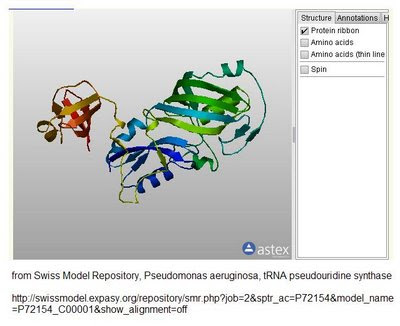
Not all the structures of proteins have yet been worked out. But below is an image from Swiss Model Repository of a protein molecule that changes RNA structure, called a pseudouridine synthase. It is from an organism known as Pseudomonas aeruginosa. It works on a different RNA, called tRNA, but it gives you an idea of the type of molecule needed to change the shapes of RNA into what you have seen on my posts about spliceosomes. (I have added the link to ExPASy HERE. When you get to that page, you can access Swiss Model Repository which computes these models.)


The findings in the article to me imply that the ancestors of eukaryotes must have had these complex mechanisms from the start. The theory that these cells and the bacterial prokaryote cells had a common ancestor is wearing thin. As Hugh Ross and others have explained, findings in geology have shown that not much time lapsed between the cooling of the earth and the start of biological life. The spliceosomes and the DNA and proteins needed to form them have thousands of atoms in specific positions to allow them to do specific activities. These atoms have astronomical numbers of potential combinations, but only extremely rare combinations will work. As I said, it's an exciting time in biology.

Tuesday, July 29, 2008

Spliceosomes U4-U6

I'm catching up from weekend guests, so I'll just show you the rest of the major spliceosomes today and comment on the whole process next post. They complete the set which carries out the process of intron removal in RNA, which you can see in previous posts (spliceosome label at bottom of post).


Friday, July 25, 2008

Spliceosome U2


The DNA of a cell must be copied to RNA and that in turn is eventually used to create proteins. The RNA in a "true" cell, or eukaryote, is often edited before it becomes the template for the proteins. I showed the first part of this process and gave some background in a post a few weeks ago which you can see HERE. By the way, the picture here is only partial and shows the "major" but not the "minor" splicing mechanism. You can see that by going to Wikipeida HERE.

Some areas are removed before it goes on to produce protein (the editing part). There are five molecules which take part in the regular splicing activity (a different set occurs in some reactions, but I will not go into that). I showed the first part of the splicing process and the U1 molecule in the first post. The top picture today shows the rest of the splicing reaction and the picture below shows the U2 RNA molecule (Wikipedia HERE).

Tuesday, July 22, 2008

Vacation

Hello! It's nice to be back from "vacation" although I think I did as much on vacation as off. For one, I finished the second draft of my book. Now my husband, a writer and great editor, gets to read it and give me his advice. We belong to a writing group which meets from Sept. to May. I'll probably print out some copies for them to read and edit. I'll tell you more about it as we get closer to printing. And no, it doesn't have anything about ID in it. We self-publish, because I like to do all aspects of the book including the cover. I'm a slow writer and don't want to get into any deadlines with publishers. I do presentations on Intelligent Design, so I go back and forth between working on that and my book. And, this blog has become another enjoyable writing experience for me.

Another thing we did on my break was to sell our first items on ebay. It was interesting, since it did not go as smoothly as I hoped, but we got a wonderful price for the items we sold. They were 4 old TUCO puzzles, which have very thick pieces and were in my family for about 50 years. The puzzles were in good shape, although the boxes a little worn. I enjoyed watching the board of the puzzles for sale. The TUCO company had a lot of different puzzle pictures.

Next post, I'll show you more about the spliceosome of the cell. Then I will start telling you about some fascinating stories in the history of science.

Friday, July 4, 2008

July 4

May you have a blessed July 4th. I'm going to take a "staycation" for a week or two. In Michigan, one has to enjoy nice weather when one has it.

Hope you are having a good summer. I will be back soon.