Friday, July 24, 2020

Creation Biologists


The term "Creationism" is often associated with a belief in a young Earth of several thousand years. However, all Christian Creationism indicates a belief that God created our universe, life and diverse species. Therefore, some Creationists think a Big Bang, billions of years ago, started things rolling. The question many are grappling with is how, in the sense of in how much time and by what means, God did it.

Some Christians don't think it is very important for us to know the details. They say that faith in the Trinity (Father, Son, Jesus Christ, and Holy Spirit) is the focal point, and they are right about that. However, in the culture of our day, two of the factors that draw many people away from our faith are philosophical materialism and scientism, which go hand in hand. Scientists in general insist we may not even consider that God formed anything physical, such as a species (much less life), directly. Science, they say, has all the answers and religious belief only gets in the way. Many Christians therefore emphasize the need to be precise about where they think God truly came into the Creation process.

Humans are complicated and honest motives vary, much less accusations of dishonest motives from various sources. Christians are suspected of disguising the truth no matter our knowledge of facts, or being so unintelligent that we fail to see that scientists will figure it all out in the end. To make things worse, among Christians there are some deep disagreements of opinions, especially when it comes to evolution of life.

In contrast to Christians who believe God directly created life and at least some of its types supernaturally, there are advocates of "Theistic Evolution" (TE) who think God made species, including humans, through the Darwinian processes of mutation and natural selection. Their science is basically the same as the secular scientists' version, except that we are supposed to imagine God was somehow involved.

One of the main proponents of TE has been Francis Collins, MD, PhD, director of the National Institutes of Health in Bethesda, MD. He has made it a mission to convert Christians to Theistic Evolution. Why would this difference matter so much?

Dr. Collins promotes research that includes the use and destruction of human embryos and human fetal tissue. He encourages human cloning and human-animal chimeras, that is, the mixing of animal and human genetic material in single individuals. David Prentice, PhD, and vice president and research director of Charlotte Lozier Institute, a life-promoting agency, called for a replacement of Collins as director for NIH in an article in USA Today (April 25, 2017), linked HERE. Prentice provided background material that clearly documented Collin's stance on these issues. The link is HERE. Information on Dr. Prentice is HERE.

Collins says research on human fetal and embryonic tissue is needed for the sake of improving medicine. But this falls into the category of those in power profiting from the helpless and oppressed. Anyone who considers the human fetus and embryo “real” humans can see the problem.

Many people are convinced that the worldview of totally materialistic evolution blunts the idea of the dignity of humans and their worth. Though some think this reasoning does not follow, those who don’t see the value of the forming yet unborn humans may have subtly obtained this mindset from the very pervasiveness of the Darwinian theory, which is based on random events. How seriously should we take ourselves if we came about by accident? Even Christians become confused, especially with the emphasis our culture has, not only on science, but on philosophical materialism.

Another aspect of evolution in the devaluing of human life is the potential for racism. I have an article from a prominent research journal that describes a study about DNA. Though the “Out of Africa” human evolution and migration theory pervades our thinking, I was still shocked to see that the DNA of people of African descent was actually used as research material for “less evolved.” There have now been fossils of humans found in other areas of the world that have put this long and hard-held theory into question (see article HERE), and the whole theory of humans from non-humans should be put to rest this instant.

Many people fear Creationism stops science. But in just one example, Darwinian evolutionists had insisted that much of our DNA was “junk,” and this is turning out to be untrue. This belief had stopped science for many years, as well as other similar cases. An atom is an atom, no matter your faith. We can all make progress together.

“Creation Biology” (CB) is a catch phrase, since it doesn’t spell out all aspects of Creationism, including age of the Earth. But CB points out the falsification of Darwinian evolution no matter whether the Earth is 4-some billion years old or several thousand. CB infers that no human being was born of any other species. “Creation Biologists” can advocate that life itself was created supernaturally by God and that not all of the other diverse life forms came from a single origin. We can believe all human life is very special, created directly by God in His own image.

Creation Biology is obviously a subject of great interest to me. I would like to someday get involved in discussions at Catholic Answers Forums about Creationism now that I finished the latest CB series on the blog, with the related posts since October of 2019 in particular. Though I’ve been writing about biology a long time, I learned a lot in doing these recent entries and I am glad for the time and opportunity I had to do them. I’d like to share them more than I am doing by writing my blog alone, and yet I want to learn about some other subjects before getting tied up at the Forums, which looks pretty inevitable if you get involved with anything related to the subject of Creationism or evolution. I ask God to guide me, so I do my best to try to follow Him and trust He will use this work as He will. Thanks to anyone who has taken time to read my posts.

Tuesday, July 7, 2020

Type III Secretion System

Some bacteria use "secretion systems" (SS) to do various things: they help humans digest food, they are capable of horizontal gene transfer, and some use them to inject toxins into their victims. There are different types, and I had described two of them, Type II SS and IV, in a previous post HERE. Since the beginning of gene sequencing in the 1990s, scientists are becoming aware that not all genes are following the expected Darwinian tree. So they used horizontal gene transfer as their explanation: some genes went to different species under different conditions than the strict mutation and natural selection model that Darwin proposed. I also discussed that in the post mentioned above.

But the Type III secretion system (T3SS) itself has been used as a possible structure that could be a Darwinian source for the bacterial flagellum, a tiny biological tail with a motor that is used as a model of design by the Intelligent Design movement. I would like to describe this T3SS to add to the previous information I have on Types II and IV.

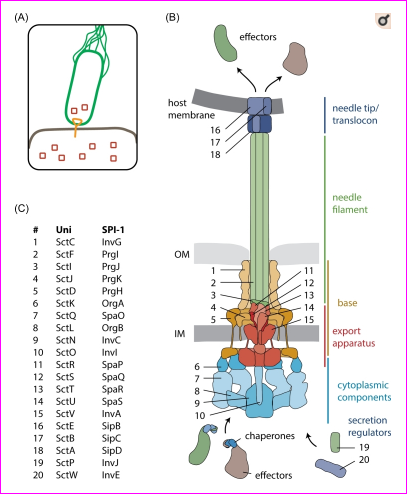
I’ll start with an overall image of one which is from the article: S. Wagner et al., “Bacterialtype III secretion systems: a complex device for the delivery of bacterialeffector proteins into eukaryotic host cells,” FEMS Microbiology Letters 365, 19 (Aug. 9, 2018). FEMS stands for Federation of European Microbiological Societies. I'll call this the Wagner image.

(This is an Open Access article distributed under the terms of the Creative Commons Attribution-NonCommercial-NoDerivs licence 4.0 International.)


The drawing at top left (A) shows the bacteria using the T3SS to inject toxin into its victim. The system with number keys (B) is at right. The numbers label the protein components of the system. The lists at lower left (C) are two separate protein labeling systems for the T3SS. More details can be found at the article link given above.

As you can see, 20 different proteins are listed for this general depiction of the T3SS. Some are used multiple times.

More detailed looks at the needle complex are shown at the Research Collaboratory for Structural Bioinformatics Protein Data Bank (RCSB) entry 6Q15. These are based on an article from J Hu et al., "T3S injectisome needle complex structures in four distinct states reveal the basis of membrane coupling and assembly," Nature Microbiology 4, 11 (Nov. 2019): 2010-2019. The abstract is at the same web page given for the image (link at entry number). A side look:


The proteins interact with both the same and different proteins to form working structures. In the needle complex structure pictured above, the webpage lists 8 of the 20 proteins pictured in the Wagner image. Details of each are given, such as the number of amino acids per protein and depictions of the proteins isolated from each other. The first one listed, PrgK (number 4 on the Wagner image), has 252 amino acids. The second, PrgH (no. 5 on Wagner), has 392. The third, InvG (no. 1 on Wagner), has 562. The other counts of amino acids in this group of 8 range from 80 to 263.

And part of a base from another angle at RCSB 6PEM (same article citation as above is at this webpage, although this webpage lists only 6 proteins):


At the website, these images can be manipulated in 3D. Hit the 3D View Structure link below the image.

Though I've had images before in this blog of the 20 biological amino acids, I'll show a chart here. They join together in a specific chemical formation to make the various proteins of our bodies.


These subunits must have the right shapes and charges in the right places for the T3SS to work. The system also requires energy from the respiration of the cell, an extremely complex system in its own right. It takes DNA and separate proteins to make these proteins and the bacterial cells must conduct other life-sustaining metabolism in the meantime.

A last image shows even more of a close-up of a protein in the T3SS, called SipD, which is needed for the invasion of other cells (in the Wagner image it is #18). A chain has 346 amino acids, but several chains combine for the whole protein. The image comes from the article, M Lunelli et al., “Crystal Structure of Prgi-Sipd: Insight Into a Secretion Competent State of the Type Three Secretion System Needle Tip and its Interaction with Host Ligands,” PLOS Pathogens 7, 8 (Aug. 2011): e1002163. More information is at RCSB, entry 2YM9:


Citation for RCSB: Helen M. Berman, John Westbrook, Zukang Feng, Gary Gilliland, T. N. Bhat, Helge Weissig, Ilya N. Shindyalov, Philip E. Bourne, "TheProtein Data Bank," Nucleic Acids Research 28, 1 (Jan. 1, 2000): 235–242.

As stated before, the T3SS is used as an example of a source for the bacterial flagellum, but it is described in authentic scientific literature as a complex system itself. Complex systems are found throughout all life and needed for survival. Together, they have almost countless atoms working in fabulous harmony. Where is their source?

Though Intelligent Design Theory technically defines the term "complexity" in relation to computer language, we do not have to be computer experts to understand the familiar meaning of the word "complex." People who believe God directly formed life can easily cite Romans 1:20, written by the Apostle Paul, "Ever since the creation of the world, his invisible attributes of eternal power and divinity have been able to be understood and perceived in what he has made…" (NABRE).

We all know about Galileo and the shifts of assumptions after discovery of planetary moons. But in the same way humanity was surprised because of what we learned in the scientific discipline of astronomy, we may well be even more surprised by biology. Many think a paradigm shift away from God came through reason, but the way back to God is even more logical if we cleanse ourselves of false premises. Let us not be afraid of dire "God of the Gaps" warnings. Of Jesus Christ, Paul said, “For in him were created all things in heaven and on earth…all things were created through him and for him” (Col. 1:16). Have faith that the more we discover, the more our knowledge will point us to appreciate all of God's handiwork.

Saturday, July 4, 2020

A Blessed Fourth to You


May all of us in the US have a blessed Fourth of July, with thanks to the Lord for what we have and sincere desire to do better where we fail.

May all people have the liberty that hearts long for.


Saturday, May 30, 2020

Cookie Evolution


Often, people who misunderstand how the theory of evolution is supposed to work do not realize the vast complexity of biological mechanisms. They look, for example, at fish and land animals and imagine changes in environment are all it takes to bring about transformation from one species to another. All you have to do is invoke small steps.

To those who know more about biology, the formulation sounds a little like this:

“Cookie Evolution.”
  • a. One of my cupboards has a baking goods storage environment and therefore wheat randomly became flour and cane syrup by chance transformed into sugar to fill this space.
  • b. There was an empty and therefore potential environment in my cookie jar.
  • c. By chance, my flour and sugar randomly combined with butter and eggs from my refrigerator environment.
  • d. The combined features evolved when they passed through an oven environment.
  • e. My cookie jar environment got filled by nature alone!

The same could be said for birthday party environments being filled by birthday cakes, etc., but you get the picture. These are called “just so” stories because they state in part what is there but do not explain anything in a truly scientific way. You can use your imagination to make up a scenario, but that does not mean it actually happened that way!

Researchers, university professors and other so-called science promoters say things and show their videos that look good to the public on the surface but are often theory instead of fact, or at most partial facts without showing what is missing.

Does it stop science to think that God supernaturally created some animals and plants directly? Looking at my “Cookie Evolution” above, it is much more logical to assume that thinking people were behind the making of flour, sugar, and butter, bringing the ingredients together in a beneficial proportion and cooking them optimally for the best outcome. New discoveries about wheat or sugar cane, for example, would never replace the need for the involvement of living agents. I believe there is a point at which we can say that new discoveries about science will not displace the need for a Creator.

Even if feedback mechanisms seem to help organisms adapt to the environment, the proteins and other physiological systems must be there to make it work. With every species, new proteins, called ORFans, are found, at the rate of about 1 in 10^70 being functional (see my previous post for further info HERE). This is what so many evolutionists skip over completely without any attempt at explanation.

What can a layperson do about false information? Try to look at the raw facts. The word "evolution" is inserted into a great deal of published scientific papers whether it is proven or not. Just skip over the word and see what was really discovered about genes, proteins, molecular mechanisms or whatever the focus of the experiment. 

And you also have to consider what is not proven. Give a fair hearing to Creationists because they are the ones who are willing to look at this side. Do not discount what they say just because they belong to a certain group. Look at credentials—there are more and more Intelligent Design advocates and Special Creationists coming from the most prestigious learning institutions of our day.

Most importantly, be honest with yourself. This can be painful, as I know from experience. But I also know that a change in perspective can be very, very liberating.

Catholics believe in the virgin birth of Jesus Christ. Right there we are looking at a supernatural genetic occurrence: the change of two X chromosomes to one X and one Y in one generation.

Personally, I think there may have been some cases in which one species may parent another that is not that far removed from it. On the other hand, I do not believe an ape of any kind gave birth to a human, either with intermediates or without. I think God created humans directly in a supernatural way. This is called Special Creationism (SC).

Jesus Christ knew human nature. He warned followers that we would be insulted for our faith in Him but He also said we would be rewarded for that very persecution (Matthew 5:11-12 NABRE). This is not to say we should promote SC for rewards alone. It is to say that if we believe in SC, we should have the courage to say so, to help others see what is true.

I find that the more I learn about biology, the more I think that what stops science is the unwillingness of many individuals to look at it straight in the face.

Wednesday, April 15, 2020

Pseudogenes


Evolutionists have used what are called “pseudogenes” as proof of evolution. The pseudogenes are supposed to be broken genes that appear in multiple species that are alleged to have evolved from their ancestors. Many resemble functional genes as if there were random reproduction of the working genes and then decline of the original or duplicate due to generations of mutation and non-use. If the extra genes are broken, goes the thinking, why would they exist in various species unless they were passed along the evolutionary tree?

Fortunately, there are scientists out there who are actually studying biology. The pseudogenes are turning out to have very important functions, often concerning gene regulation. One report is by Cheetham, Faulkner, and Dinger, “Overcoming challenges and dogmas to understand the functions of pseudogenes,” Nature Reviews Genetics 21 (Dec. 17, 2019):191–201. Their article Abstract says volumes:

Pseudogenes are defined as regions of the genome that contain defective copies of genes. They exist across almost all forms of life, and in mammalian genomes are annotated in similar numbers to recognized protein-coding genes. Although often presumed to lack function, growing numbers of pseudogenes are being found to play important biological roles. In consideration of their evolutionary origins and inherent limitations in genome annotation practices, we posit that pseudogenes have been classified on a scientifically unsubstantiated basis. We reflect that a broad misunderstanding of pseudogenes, perpetuated in part by the pejorative inference of the ‘pseudogene’ label, has led to their frequent dismissal from functional assessment and exclusion from genomic analyses. With the advent of technologies that simplify the study of pseudogenes, we propose that an objective reassessment of these genomic elements will reveal valuable insights into genome function and evolution.

There is increasing realization that there are reasons that some genes resemble each other. Ironically, these particular authors are still thinking in the evolutionary mode. Don’t they realize the “pejorative inference of the ‘pseudogene’ label” of which they speak comes 100% from evolutionists? But what at the end they say is true. Their reassessments may give them the ultimate insight: that evolution is very minimal in explaining the diversity and wonder of life.

A major study called ENCODE,  reported by the ENCODE Project Consortium, "An integrated encyclopedia of DNA elements in the human genome,"  Nature 489 (Sept. 5, 2012): 57-74, showed that much more of the DNA in our cells is being actively used than researchers ever expected. One of these scientists is Dr. Francis Collins, director of the National Institutes of Health in Bethesda, Maryland. Before, they had called most of the DNA “junk” which they assumed was from evolutionary mutations. Dr. Collins admitted he was wrong in using the term “junk” and said he would no longer refer to DNA in that way.

Now pseudogenes, which the prominent evolutionists have used as one of their prime examples as worthless, is turning out as valuable genetic material that is currently undergoing much biomedical research which may lead to cures in cancer and other diseases.

Yes, genes mutate. I’m a doctor of veterinary medicine, I know about that. But I also know that the numbers of mutation and the precision of genetics don’t add up. 

When are people going to get over themselves and start thinking outside the box? When can we end the “Galileo Complex,” as Logan Gage, PhD, Chair of the Philosophy Dept. at Franciscan University of Steubenville, calls the extreme reluctance of Catholics to allow that the Lord may have touched His own Creation along the way?

Those who call Creationists "science deniers" often do not know the science themselves. They rely on the evolutionist leaders who, as we are discovering, hold back progress more than advance it.

It is obvious that humans are intelligent creatures who want to discover the workings of the universe, both for curiosity’s sake and to protect ourselves from harm. But we are not to be rigid, either. It takes more intelligence to reach beyond black and white, not less. It is way beyond time to do so.

Wednesday, March 18, 2020

The Certain God in Uncertain Times

In this present COVID-19 pandemic, many are anxious.  I hope those who are Christians will be able to put their trust in the Lord, to experience optimistic emotions and perform helpful actions. We believe the Lord is in control.

If you are not a Christian and are worried about your future,  I invite you to get to know Jesus. I have written a booklet called Heaven's Passport which may help you overcome doubts. The page with a description and link is RIGHT HERE.  You can also click the picture of it in the right column of the home page for more description.

I pray for all of us to get through this challenge and be enlightened as to what is truly important.

Wednesday, February 5, 2020

Orphans, HGT and Secretion Systems

I'm going to give a line of reasoning that changes subject a few times, so I hope you will take your time and stay with me. I think part of the reason evolutionists get away with pushing their materialistic view is that they skip over many details.

Point 1:
Since scientists learned how to "read" the whole genome in the 1990s, they discovered a large percentage of species' genes are not related to any other lineage. At first they thought the lineages would fill in as they did more sequencing, but they eventually realized the genes did not all follow the neo-Darwinian theory. These particular ones are called Orphan, or ORFan, genes. The Orphans show up at a rate of at least 10-30% in all lineages. Wikipedia has an article about Orphans HERE. (If you read this or any other article about biology, beware that the evolution theory is usually assumed as proven. So just try to get the actual facts.) The abstract of this artice by Arendsee, Li and Wurtele, "Coming of Age: orphan genes in plants," Trends in Plant Science 19, 11 (Nov. 2014): 698-708, also speaks of orphans in all species.

Point 2:
So because Orphans became part of the overall picture, scientists are looking for other ways to justify evolution. Before, they said small mutations in genes over billions of years would bring the changes we see in species and beyond, all through life's varieties. So now they are telling us the reasons genes are not following trees is that various major mutations and duplications can happen within the non-functional part of the genome, or they go from one species to another by what is called horizontal gene transfer (HGT). I will take HGT under Point 3.

But experiments over the last 30 years have shown that functional proteins are very rare. Among the papers describing this rarity is by JF Reidhaar-Olson and RT Sauer, "Functionally acceptable substitutions in two alpha-helical regions of lambda repressor," Proteins, 7, 4 (1990): 306-16. When similar experimental results are considered, we can use the proportion of 1 in 10^70 as a guideline for function of a simple protein "fold." Folds are the parts of proteins which react with other biochemicals to process our metabolism.

It has been estimated that less than 10^50 organisms could have been alive on Earth.  This was done, among others, by Fredric P. Nelson, “Needed: A New Vocabulary for Understanding Evolution,”  Perspectives on Science and Christian Faith 58, 1 (March 2006): 28-36.

Bacteria have less than one mutation per generation. Even in billions of years, there were not enough organisms to bring about millions of unique, Orphan genes to functional structure (there are estimated to be about 10 million species on Earth). This is not even to mention the continuing discoveries that more of the "non-functional" part of the DNA is in fact useful for a variety of reasons and probably not available for mutation.

Point 3
Horizontal gene transfer is an exchange of DNA between species. The sets of proteins used in HGT, along with other functions,including the secretion of toxins, are know as "secretion systems." There are various types, and I have images of one part of a Type II and full Type IVa machine. There are good images and information of both of these systems online in a scientific article by Chen and Dubnau, "DNA uptake during bacterial transformation," Nature Reviews Microbiology 2, 3 (April 2004): 241-249.

Information about this process has been studied and the following facts are from an article by Thomas and Nielsen, "Mechanisms of, and barriers to, horizontal gene transfer between bacteria," Nature Reviews Microbiology 3, 9 (October 2005): 711-721. Although HGT does work at the single-celled organism level, most changes are deleterious. Of the few that do persevere and spread, they are most often involved in simpler biochemical pathways, even in antibiotic resistance. They do not affect the most central workings of the cell, such as DNA replication. Even so, it takes about 20-50 already functional, coordinated proteins to perform HGT.

Scientists and others have used these systems as examples of evolutionary sources for the bacterial flagellum system, which in turn is a model of design given by Intelligent Design advocates. But the anti-design scientists don't explain how the proteins of these systems arose and organized into working machines of their own.

Type II Secretion System

The first image is one protein of a Type II secretion system. It is from the work of Abendroth et al., "The X-ray Structure of the Type II Secretion System Complex Formed by by the N-terminal Domain of EpsE and the Cytoplasmic Domain of EpsL of Vibrio cholerae," Journal of Molecular Biology 348, 4 (May 13, 2005): 845-855. The protein is called Cyto-Epsi," and the PubMed Abstract in part describes it:

Gram-negative bacteria use type II secretion systems for the transport of virulence factors and hydrolytic enzymes through the outer membrane. These sophisticated multi-protein complexes reach from the pore in the outer membrane via the pseudopilins in the periplasm and a multi-protein inner-membrane sub-complex, to an ATPase in the cytoplasm.

The image shows a protein that has one type of chain with 254 amino acids, but it is a 2-mer, which means there are two of the same type in the molecule, totaling 408 amino acids. Amino acids are the subunits of proteins and have an average of about 20 atoms. The double chains of the 2-mer are apparent from the mirror-type image. Remember, this is just part of the system.


More information, including the journal abstract, about Cyto-Epsi from Type II can be found at RCSB PDB 1YF5.

More information on Type II secretion systems at Wikipedia HERE.

Type IVa Secretion System

The second image is a Type IVa secretion system (piliated, which means the center has a separate protein string that the system made). The journal article which describes this is by Chang, et al., "Architectural model of the type IVa pilus machine," Science 351, 6278 (March 11, 2016): aad2001. The full Science article is online with images at the link in the title.

This image of the Type IVa Pilus Machine is from Uniprot, another protein database. It is pictured at the links to the individual proteins that make up the machine. For example, one of the proteins is called PilB, and when you go to Uniprot PilB entry (with the right browser setup) you get this image. It is under the heading "Structure" and you can even manipulate the 3-D image! Give it a try at PilB entry Q1D098. Once again, this machine is not the whole system.


More information about the Type IVa pilus machine is at RCSB PDB 3JC8.

At the RCSB PDB 3JC8 link, there are Protein Feature view charts for each of the 9 types of proteins that make up this particular machine. The third image here is the Type IVa pilus assembly protein ATPase PilB from the organism, Myxococcus xanthus (strain DK 1622). The 9 types of proteins (entities) have multiple chains of each. In this example, PilB has 566 amino acids in each of 6 chains (the blue lines).


The amino acid sequence of PilB is what each of the blue lines represent. This particular one is shown here from the Uniprot website, each letter standing for a specific amino acid:


The total amino acids (also called residues) for this machine are listed at the site as: 37,468. Total atoms: 107,640. All have to interact in size, shape and charges for the machine to be in working order.

More on Type IV Secretion Systems at Wikipedia HERE.

If you've gotten to this point, thanks for following along. I hope you see these systems are themselves intricate, not easily explained away.